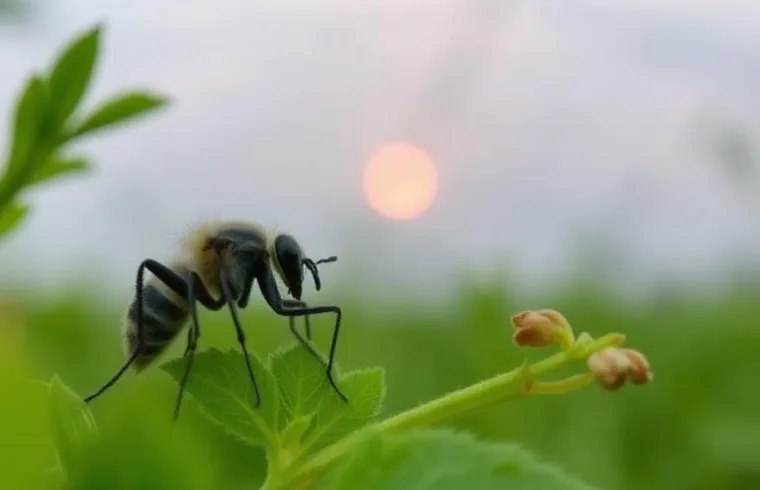
Stockholm, Sweden — Industrial insect farming, once hailed as a climate-friendly protein source, is coming under scrutiny as new research questions whether it delivers the environmental benefits often claimed.
A report by the Stockholm Environment Institute (SEI), Leiden University, and the European Institute for Animal Law & Policy finds that insect farming in temperate, high-income countries such as those in Europe and North America shows highly variable environmental performance.
The study, Rethinking insects as alternative protein, comes as the sector faces financial headwinds after years of strong investor and government backing.
Sustainability claims challenged
“Insect farming is often framed as a sustainability solution,” said Camilo Garzón, Research Associate at SEI. “But the benefits depend on how insects are produced and what they replace in our diets. On current evidence, the environmental case is far less clear-cut than often assumed.”
The report draws on life cycle analyses and concludes that insect protein may not live up to its reputation as a low-impact alternative to conventional meat. While land use is generally low, it can exceed soymeal if insects are not raised on organic waste. Water use data remains limited, with wide variation between species.
Greenhouse gas emissions also vary sharply. In temperate regions, insect protein production ranges from 3 to 35.5 kgCO₂eq per kilogram of protein, with a median of 13.5. That compares with chicken at 18–36 and pork at 21–53. While insects remain far below beef’s footprint of 75–170, they overlap with poultry and pork — and often replace soymeal or fishmeal, which have lower emissions.
Practical hurdles
The potential for low-impact insect farming depends on conditions rarely met in practice. Facilities in cooler climates require heating, driving up energy demand. Renewable energy use in the sector remains limited. Regulatory barriers also restrict large-scale use of organic waste as feed, undermining one of the industry’s touted advantages.
Limited consumer uptake
Despite marketing efforts, most farmed insects do not reach human diets directly. Consumer uptake has been modest, with insect ingredients appearing mainly in niche products such as pasta or cookies, often supplementing rather than replacing meat. A large share of production goes into feed for livestock and aquaculture.
“If insect production mainly feeds other animals without reducing meat consumption, policymakers should ask whether these investments are transforming our food system or simply reinforcing it,” said Cleo Verkuijl, Senior Scientist at SEI.
Wider concerns
The report also highlights ecological risks from accidental releases and raises ethical questions as evidence of insect sentience grows. It warns that investment in insect farming may divert resources from alternatives such as plant-based and cultivated proteins, which show clearer potential to reduce reliance on conventional meat.
Outlook
Researchers argue that policy and investment decisions should be guided by robust evidence of environmental performance. While insect farming may face fewer barriers in tropical and lower-income countries — where energy demand is lower and organic residues more available — the evidence base there remains thin.
In high-income regions, the promise of insect farming now faces two critical tests: environmental performance and economic viability. Both, the report suggests, are increasingly in doubt.