TOKYO, Jan 19 – An international team of researchers has confirmed the presence of chorus emissions – electromagnetic waves generated by electrons resonating with plasma – near Mercury, marking a breakthrough in planetary space science.
An international team from Kanazawa University (Japan), Tohoku University (Japan), LPP (France), and partners has demonstrated that chorus emissions – natural electromagnetic waves long studied in Earth’s magnetosphere – also occur in Mercury’s magnetosphere, exhibiting similar chirping frequency changes.
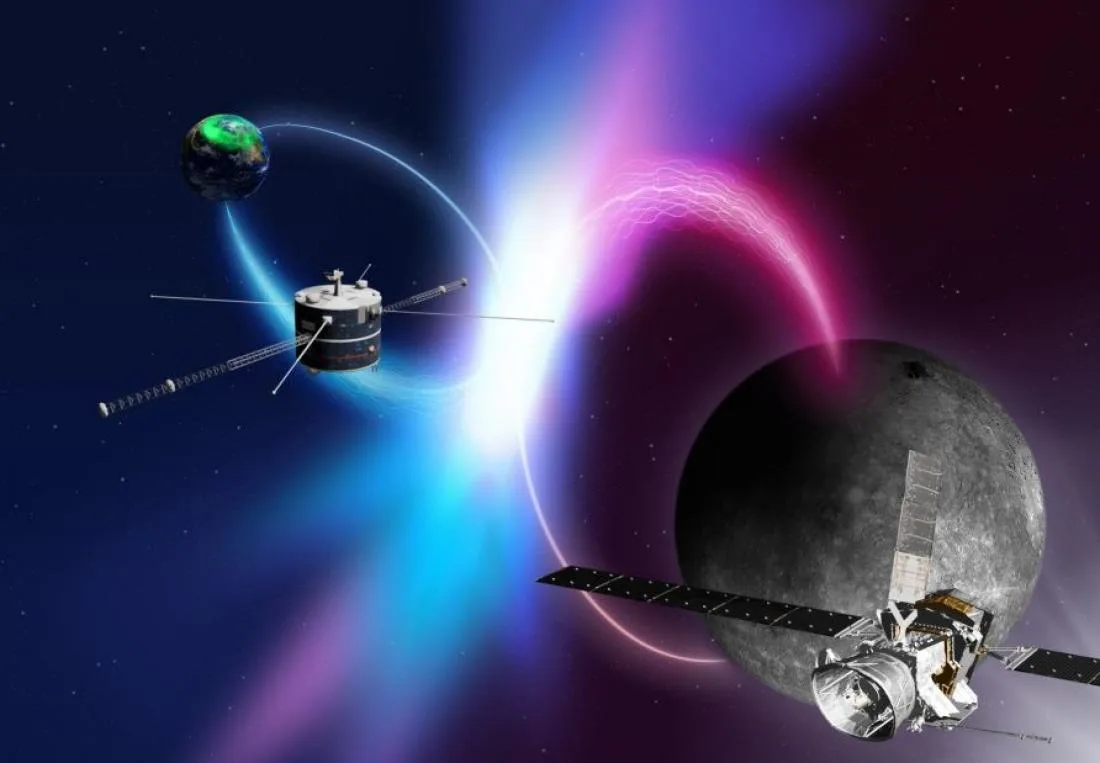
Using the Plasma Wave Investigation instrument aboard BepiColombo’s Mercury orbiter Mio, six Mercury flybys between 2021 and 2025 detected plasma waves in the audible range.
Comparison with decades of GEOTAIL data confirmed identical instantaneous frequency changes. Researchers said this provides the first reliable evidence of intense electron activity at Mercury, advancing understanding of auroral processes across the solar system.
The discovery was made using the Plasma Wave Investigation instrument aboard BepiColombo’s Mercury orbiter Mio, which detected natural plasma waves in the audible range. The findings suggest that Mercury, despite its magnetic field being only one‑hundredth that of Earth’s, hosts similar plasma processes.
Chorus emissions are known on Earth to drive the formation and loss of radiation belts, producing rising and falling tones often described as “birdsong.” Data from Japan‑U.S. GEOTAIL satellite missions, which observed Earth’s magnetotail for 30 years, provided the benchmark for comparison. Mercury’s plasma wave signatures matched GEOTAIL’s chorus patterns, confirming rapid frequency variation and concentration on the dawnside region where energetic electrons flow.
Researchers said the results demonstrate the universality of chorus generation across planetary magnetospheres and support predictions of cold electrons around Mercury. The findings also indicate that efficient electron acceleration occurs even in Mercury’s weak magnetic field.