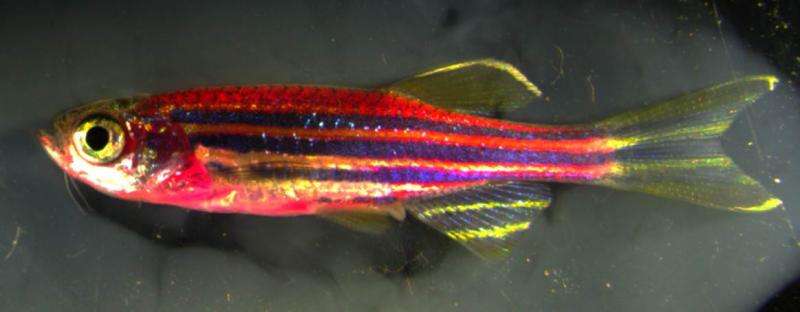

Scientists from Duke University genetically engineered a zebrafish that glows in an array of colors, to visualize how hundreds of individual cells work at once in regenerating tissue.
The labeling technique, dubbed Skinbow, uses a gene that codes for red, blue, and green fluorescent proteins and allows the zebrafish to randomly express different combinations, resulting in more than 70 hues that can be distinguished under a microscope.
As an adult, the fish looks like it has a magenta tone, but under a microscope each individual cell has its own slightly different hue.
The team, led by Kenneth D. Poss, professor of cell biology at Duke University, also designed a software that enables researchers to track individual cells movements in a live animal over days or weeks at a time.
[pullquote]The researchers found it takes about 20 days or so for the entire population of the fish’s skin cells to turn over.[/pullquote]
The color-coding system, described in the journal Developmental Cell, can help determine how cells migrate to repair injuries and regenerate tissues.
“Before we can fully understand tissue regeneration, we need to be able to monitor what individual cells are doing,” Poss said in a university statement. “This is a cutting-edge way to visualize hundreds or thousands of cells at once in a regenerating tissue.”
In one experiment, to see how skin responds to injury, researchers amputated part of the zebrafish fin, a part known to regenerate. Skin cells moved from below the amputation site to cover the wound, while new cells were created at a quick pace. Some cells even grew in size temporarily to cover the surface tip of the regrown tissue.
“These are quite different cellular mechanisms, and one would not be able to detect the sequence or the appearance of these mechanisms without being able to track all or most of the cells on the surface of the fin,” Poss said.
The researchers, also used the system to track the movements and changes in hundreds of skin cells over three weeks and found it takes about 20 days or so for the entire population of the fish’s skin cells to turn over.
Up next the team hopes to use Skinbow along with other imaging techniques to understand in greater detail how things such as drugs, or cancer, influence the cellular mechanics behind tissue regeneration.