

GENEVA – For the first time in its history, CERN has secured backing from private donors, including individuals and philanthropic foundations, to support one of its flagship research projects.
A group of CERN supporters, including the Breakthrough Prize Foundation, the Eric and Wendy Schmidt Fund for Strategic Innovation, and entrepreneurs John Elkann and Xavier Niel, have pledged funds towards building the Future Circular Collider (FCC), a proposed successor to the Large Hadron Collider (LHC). The commitments, estimated at about 860 million euros ($1 billion), mark one of the largest private sector investments in fundamental physics research.
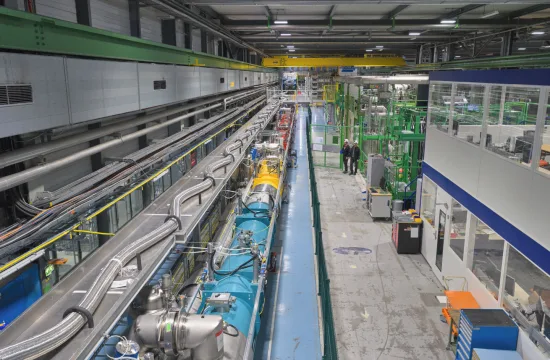
CERN says a more powerful collider is needed to advance efforts to explore and understand the universe. If approved by its member states, the proposed Future Circular Collider (FCC) would be among the most ambitious instruments ever built to study the laws of physics at a fundamental level. The project aims to address outstanding questions in particle physics, particularly those linked to the Higgs boson, while deepening knowledge of the Standard Model and opening the door to discoveries beyond it.
At the same time, the FCC would drive the development of innovative technologies in many fields and generate substantial positive benefits for society. With its circumference of 91 kilometres, the FCC would succeed the Large Hadron Collider in the mid-2040s.
Based on strong input from the international particle physics community, the FCC has been recommended as the preferred option for the next flagship collider at CERN in the ongoing process to update the European Strategy for Particle Physics, which will be concluded by the CERN Council in May 2026.
“For the first time, private donors are partnering with CERN to build a major research instrument that could advance understanding of fundamental physics and the universe,” CERN Director-General Fabiola Gianotti said. She added that their support is vital to the prospective Future Circular Collider (FCC) and to enabling future generations of scientists to expand the frontiers of discovery and technology.
“Understanding the fundamental nature of our Universe is the mission that unites humanity,” said Dr S. Pete Worden, Chairman of the Breakthrough Prize Foundation. “We’re proud to support the creation of the most powerful scientific instrument in history, that can shed new light on the deepest questions humanity can ask.”
“The Future Circular Collider is an instrument that could push the boundaries of human knowledge and deepen our understanding of the fundamental laws of the Universe,” said Eric Schmidt.
“Beyond the science, the technologies emerging from this project could benefit society in profound ways, from medicine to computing to sustainable energy, while training a new generation of innovators and problem-solvers. Wendy and I are inspired by the ambition of this project and by what it could mean for the future of humanity.”
“CERN’s Member States are extremely grateful for the interest expressed by our donors in contributing to the funding of the Laboratory’s next flagship project. This once again demonstrates CERN’s relevance and positive impact on society, and the strong interest in CERN’s future that exists well beyond our own particle physics community,” said the President of the CERN Council, Professor Costas Fountas.
The FCC has also been included among 11 proposed “Moonshot” projects in the draft Multiannual Financial Framework for the years 2028-2034, released by the European Commission in July.
A decision by the CERN Council on the construction of the FCC is expected around 2028.