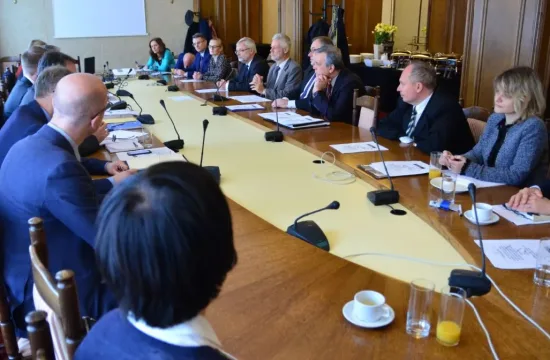


INTERLAKEN, Switzerland – The European Space Agency (ESA) wrapped up its 345th Council meeting with decisions aimed at bolstering Europe’s role in human spaceflight, deepening international cooperation and advancing planetary defence.
The two‑day meeting, hosted by Switzerland, saw ESA Director General Josef Aschbacher and member states thank the Swiss delegation and Council Chair Renato Krpoun for their support. Delegates reviewed progress on implementing commitments made at the November 2025 ministerial meeting and discussed next steps in strengthening Europe’s space capabilities.
Among the headline outcomes, the Council endorsed the EPIC mission concept, which foresees acquiring a Crew Dragon flight in early 2028 to provide regular opportunities for ESA astronauts aboard the International Space Station. Member states also approved cooperation with Japan’s space agency JAXA on the Ramses mission to study asteroid Apophis, with Japan contributing instruments, solar arrays and a launcher.
Canada expanded its partnership with ESA by joining several programmes, including ACCESS, ERS‑EO, Moonlight and FutureNAV, following its largest subscription to ESA since 1979. The Council also reviewed preparations for the EU’s next budget cycle, reiterating ESA’s readiness to act as the technical agency for the EU Space Programme.
In space safety, ESA agreed to collaborate with the Carnegie Institution for Science to host its FlyEye‑2 telescope in Chile, enhancing Europe’s ability to track near‑Earth objects. Internally, Juan Carlos Cortés Pulido of Spain was named the next Council Chair, with Slovenia’s Tanja Permozer and Finland’s Kimmo Kanto as Vice‑Chairs. Carole Mundell and Dietmar Pilz were confirmed for renewed terms as Directors of Science and Technology.
The Council noted the first annual report from ESA’s Ethics Ombudsperson, highlighting the agency’s commitment to integrity, and approved the public release of two status reports on space transportation and ground systems. On the sidelines, ESA signed funding arrangements with Sweden and the UK to support joint projects with Ukraine’s space agency.
The decisions underscore ESA’s push to expand Europe’s presence in space while strengthening ties with international partners.