
Recycled rubber granulate made from used car tires is widely promoted as a sustainable material for playgrounds, sports fields, and running tracks. However, new research suggests that the smallest rubber particles may release harmful chemicals into the environment and pose risks to soil organisms, plants, and potentially human health.
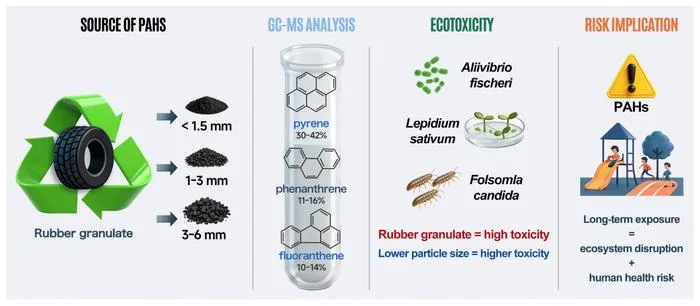
In a study published in Environmental and Biogeochemical Processes, researchers analyzed rubber granulate of different particle sizes produced from recycled vehicle tires. They found that all tested materials contained high levels of polycyclic aromatic hydrocarbons, or PAHs, a group of toxic organic compounds known for their persistence in the environment and potential health effects. Importantly, smaller rubber particles released higher amounts of these chemicals in forms that living organisms can absorb.
“Recycling tires into rubber granulate is often viewed as an environmentally friendly solution, but our results show that particle size plays a critical role in how hazardous these materials can be once they are used outdoors,” said Patryk Oleszczuk, the study’s corresponding author. “Fine rubber particles contain more toxic compounds and release them more easily into water and soil.”
The research team examined three size fractions of rubber granulate, ranging from less than 1.5 millimeters to 6 millimeters in diameter. Chemical analyses revealed that total PAH concentrations were extremely high, reaching more than 100 milligrams per kilogram in the smallest particles. These concentrations decreased as particle size increased, but even the largest granules still contained substantial amounts of PAHs.
Beyond measuring total contamination, the researchers focused on the freely dissolved fraction of PAHs. This fraction represents the portion of chemicals that can move into water and be taken up by organisms. The study found that smaller particles released the highest concentrations of bioavailable PAHs, indicating a greater potential for ecological and biological impact.
“Looking only at total chemical content can underestimate real environmental risk,” Oleszczuk explained. “The freely dissolved fraction tells us what organisms are actually exposed to, and in this case, those values were surprisingly high compared with many contaminated soils and sediments.”
To assess biological effects, the researchers conducted a series of ecotoxicological tests using soil invertebrates, plants, and microorganisms. Rubber granulate proved toxic in all test systems. Springtails, which are important soil organisms, showed reduced survival and reproduction. Plants experienced inhibited root growth, and aquatic bacteria exhibited strong toxicity responses when exposed to water leachates from the granulate. Once again, the strongest effects were associated with the smallest particle sizes.
The study also found that rubber granulate released potentially toxic metals, including zinc and copper, into water at concentrations exceeding drinking water limits. These metals contributed further to the observed toxicity, especially in leachate tests.
Taken together, the results suggest that the widespread use of tire derived rubber granulate in public spaces may have unintended environmental consequences. Prolonged exposure to weathering, sunlight, and moisture could increase the release of harmful substances over time.
“Our findings do not mean that all recycled rubber products are unsafe,” said Oleszczuk. “But they do highlight the need for size specific regulations, careful material selection, and the development of safer alternatives, especially for applications where children are in direct contact with these materials.”
The authors emphasize that recycling remains an important goal for waste tire management. However, they argue that environmental safety should be evaluated not only by the origin of recycled materials, but also by their chemical behavior and biological effects once they are placed into real world environments.