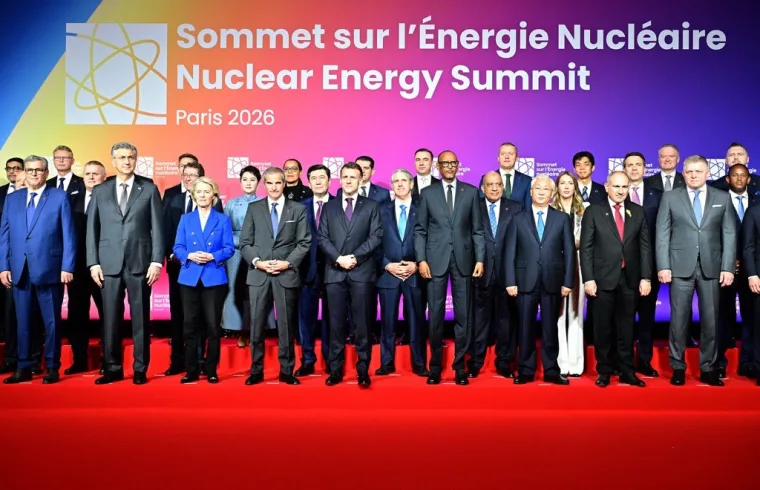
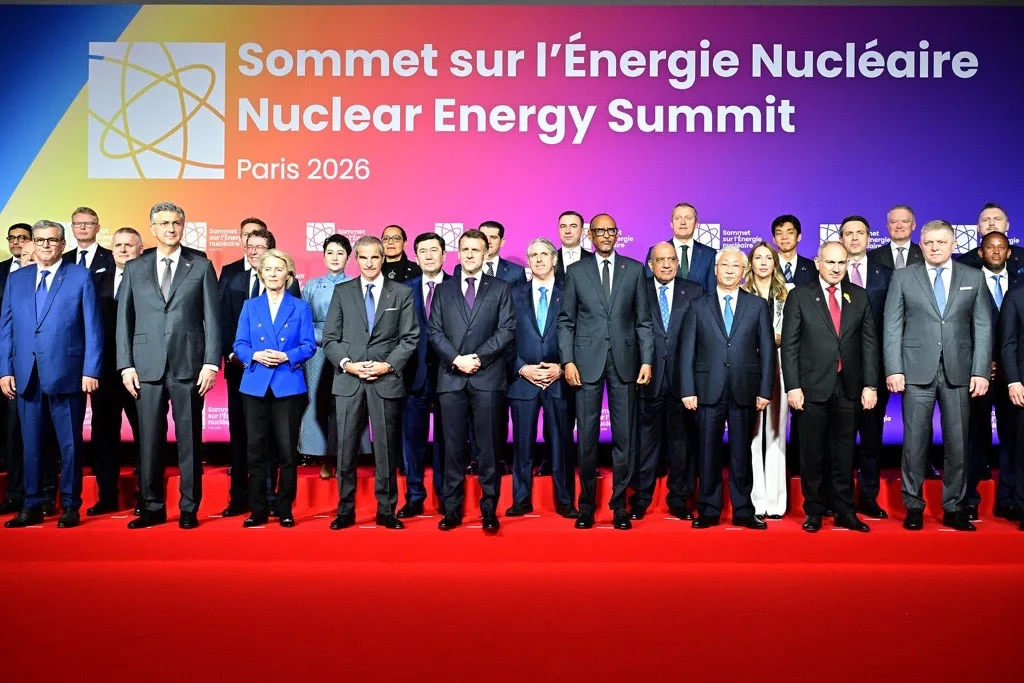
Paris— World leaders, government ministers and heads of industry, international organizations and international financial institutions gathered in Paris this week for the 2026 Nuclear Energy Summit, underscoring the central role that nuclear power plays in providing clean, reliable, affordable and secure energy at a time of rising electricity demand and geopolitical tension.
At the conclusion of the 10 March summit, hosted by the Government of France in cooperation with the IAEA, two statements were issued that reaffirmed a commitment to expanding nuclear energy as part of the global transition to low carbon energy systems and called for stronger international cooperation and increased access to financing. After the Nuclear Energy Summit held in Brussels in March 2024, state representatives highlighted the continued momentum behind nuclear energy amid rising global electricity demand.
“Nuclear power is key to reconciling both independence, and thus energy sovereignty, with decarbonization, and thus carbon neutrality,” French President Emmanuel Macron, said in his opening remarks. “We must mobilize much greater public and private financing to enable the development of new nuclear projects. Banks, insurers and international financial institutions must fully play their role if we want to accelerate the deployment of this energy that is essential for our energy security and for the fight against climate change,” President Macron added.
With countries around the world facing energy, climate and security challenges, IAEA Director General Rafael Mariano Grossi said nuclear energy is now widely recognized as an essential part of the solution. “All the conditions are now pointing in the direction of fully integrating nuclear energy into the global energy mix,” Mr Grossi said. “The momentum we are seeing today is the result of a growing recognition that reliable, low-carbon electricity will be essential to meet the world’s rising energy demand.”
Thirty-one countries currently operate nuclear power plants, which provide around 10% of the world’s electricity, equivalent to about a quarter of all low-carbon power. Dozens of so-called newcomer countries are exploring or already embarking on the introduction of nuclear power. Leaders at the summit emphasized that expanding nuclear power will require coordinated international action, strong regulatory frameworks and sustained investment.
In recent years, nuclear energy has experienced a global shift in perceptions and policies, with both public opinion polls and governments increasingly embracing a technology many previously opposed. In 2023, nuclear energy was included for the first time in the Global Stocktake of the United Nations Climate Change conference, where more than 20 countries also pledged to triple nuclear capacity to achieve climate goals by 2050. Nearly 40 countries in total have since joined that pledge.
“The reduction in the share of nuclear was a choice — and, in hindsight, it was a strategic mistake for Europe to turn its back on a reliable, affordable source of low-emission power,” said Ursula von der Leyen, President of the European Commission, who also joined President Macron and IAEA Director General in the High Level segment of the Summit
In an example of shifting policies, von der Leyen announced that the European Commission will present a new strategy for small modular reactors (SMRs), including efforts to align licensing rules across European Union (EU) member states to facilitate deployment. The EU will also create a 200 million euro guarantee to support private investment in advanced nuclear technologies and strengthen the European nuclear ecosystem, she added.
Greece also plans to set up a ministerial committee on the development of small nuclear reactors to contribute to the country’s energy mix, the country’s Prime Minister Kyriakos Mitsotakis announced at the summit.
Taking place one day before the 15th anniversary of the Fukushima Daiichi accident, the Japanese representative underscored the significant changes in the country since then. Japan has now restarted 15 reactors and is now planning to refocus on the technology to achieve clean energy security and strengthen overall affordability. “Maximum use will be made of nuclear energy on the firm premise of ensuring nuclear safety,” said Ino Toshiro, Japanese State Minister of Economy, Trade and Industry. “We are proceeding with the restarting of the nuclear power plants, incorporating the lessons of the Fukushima Daiichi accident.”
Some 413 nuclear power reactors amounting to more than 377 gigawatts electric of capacity currently operate globally. Sixty-nine reactors totalling more than 72 GWe, are under construction in 16 countries, according to IAEA’s Power Reactor Information System.
China currently leads the world in nuclear power construction and plans to continue scaling up the technology and driving innovation in the years to come, said Chinese Vice Prime Minister Guoqing Zhang said. “China has completed and put into operation the world’s first fourth-generation nuclear power plant, the High-Temperature Gas-Cooled Reactor demonstration plant. China’s Linglong One, the world’s first onshore small modular PWR, is expected to connect to the grid this year,” he said.
Mr Grossi highlighted progress in addressing one of the longstanding challenges facing nuclear energy: access to financing. He noted that nuclear projects had historically been excluded from many international financial institutions but said the situation is beginning to change, pointing to a landmark cooperation agreement the IAEA signed with the World Bank in Paris last year. Since then, he said, the Agency has expanded engagement with other development banks, including the Asian Development Bank and regional financial institutions, to help unlock funding for nuclear energy projects.
Newcomers from Africa to Asia stand to eventually benefit from such developments. Three newcomers—Bangladesh, Egypt and Turkiye—are in advanced stages of building their first nuclear power plants.
“Nuclear energy will be central to diversifying Rwanda’s energy mix while providing the stability required for industrial growth and long-term transformation,” said President Paul Kagame of Rwanda, which recently hosted an IAEA mission to assess the state of its nuclear infrastructure development and is one of several countries in Africa eyeing the deployment of SMRs to strengthen economic development.
Several leaders also pointed to emerging applications for nuclear energy beyond electricity, including industrial heat, hydrogen production and power for large data centres.
The United States of America, where nuclear power generates almost one fifth of electricity, is ramping up efforts to deploy advanced nuclear technologies including SMRs, with a stated goal of quadrupling nuclear capacity by mid-century. “The world cannot power its industries, meet the demands of artificial intelligence, or secure its energy future without nuclear power,” said U.S. Under Secretary of State Thomas DiNanno.
For Ethiopia, expanding access to reliable energy is central to its development ambitions, said Habtamu Itefa Geleta, Ethiopia’s Minister of Water and Energy, who called for stronger international partnerships to support peaceful nuclear programmes.
“We choose the atom. We choose peace. We choose development,” he said. “Together we can demonstrate that nuclear energy is not the privilege of the few, but the right of all nations committed to a prosperous future.”