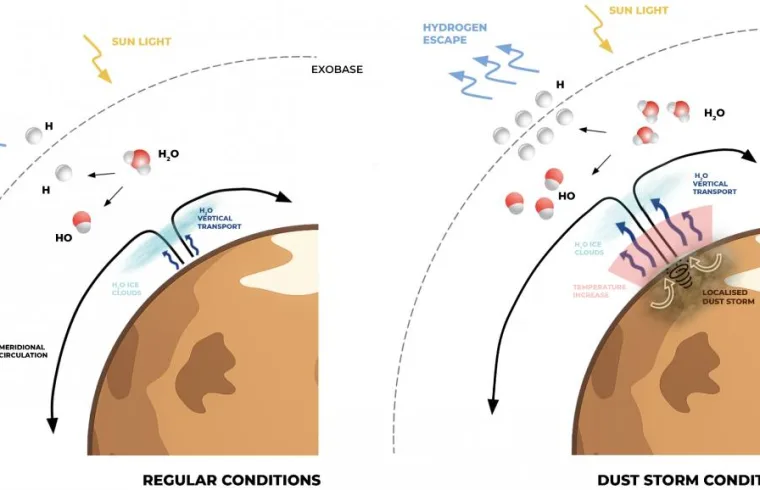
A localized dust storm on Mars may have played a key role in driving water into the planet’s upper atmosphere, offering fresh clues to how the Red Planet lost much of its water over billions of years, an international team of scientists said on Friday.
The study, published in Communications: Earth & Environment, found that during the Northern Hemisphere summer in Martian year 37 (2022-2023 on Earth), an anomalous regional storm boosted water vapor in the middle atmosphere to levels up to 10 times higher than normal. Shortly afterward, hydrogen levels in the exobase — the boundary where the atmosphere meets space — rose to 2.5 times those of previous years.
“Short but intense episodes can play a relevant role in the climate evolution of the Red Planet,” said Shohei Aoki of the University of Tokyo and Tohoku University, co-lead author of the study with Adrián Brines of Spain’s Instituto de Astrofísica de Andalucía.
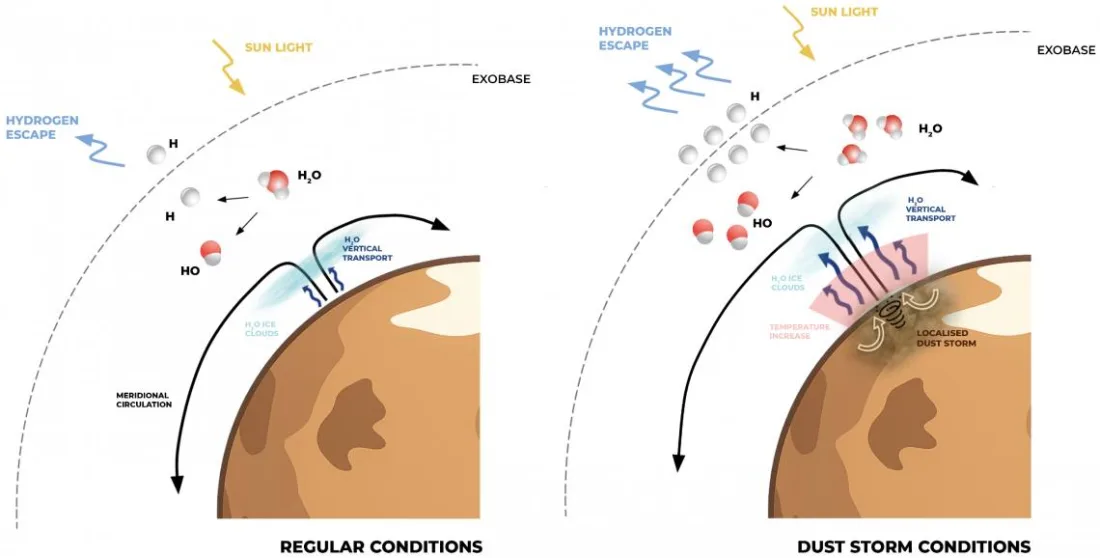
Dust storms have long been linked to water escape on Mars, but most research has focused on planet-wide events and the Southern Hemisphere’s dynamic summers. The new findings suggest smaller, regional storms can also accelerate water transport to high altitudes, where it is more easily lost to space.
The research drew on data from multiple missions, including the European Space Agency’s ExoMars Trace Gas Orbiter, NASA’s Mars Reconnaissance Orbiter, and the Emirates Mars Mission.
“This type of storm impacts the planet’s climate evolution and opens a new path for understanding how Mars lost much of its water over time,” Brines said.