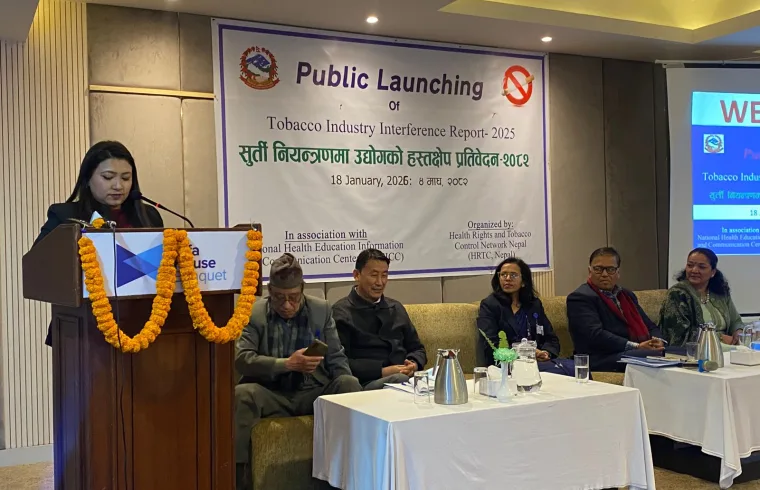
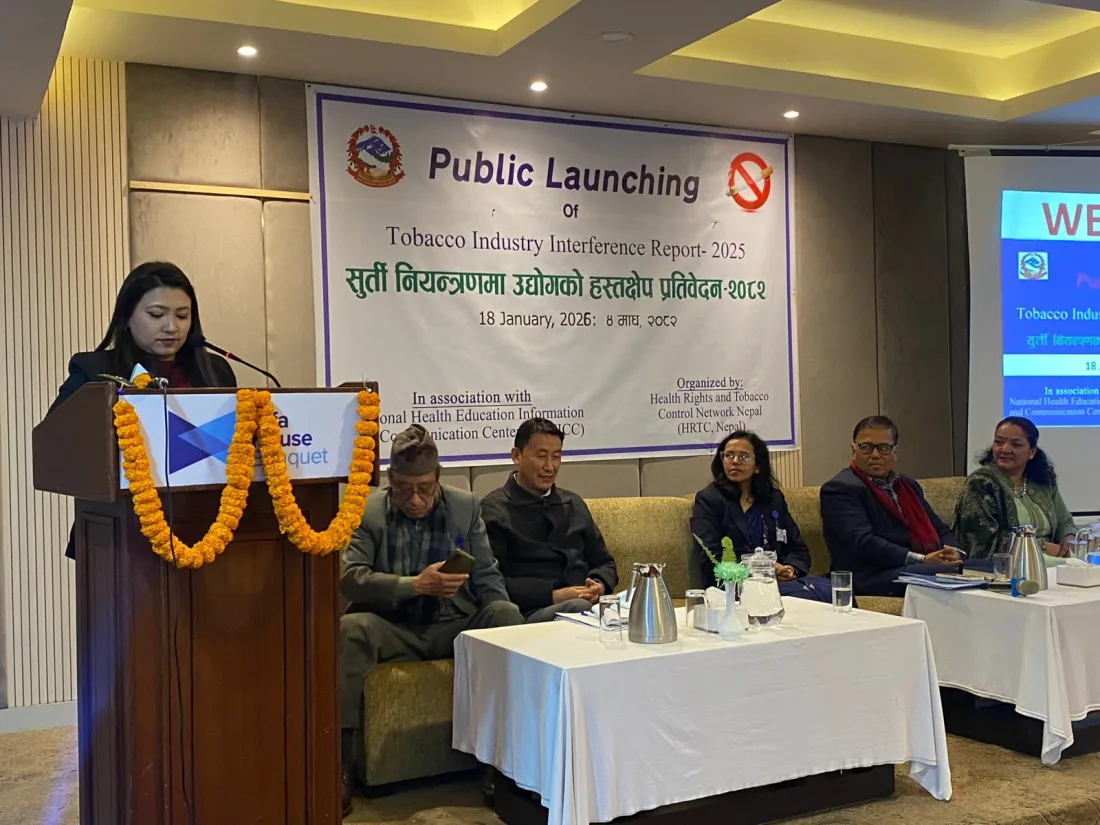
Kathmandu, Jan 19 – A new study shows that the tobacco industry in Nepal has been increasing its influence to block tax hikes and weaken public health policies.
The report, published by the National Network for the Health Rights and Tobacco Control Nepal (HRTC, Nepal), states that tobacco companies are intervening under the guise of corporate social responsibility, revenue consultation, gifts, and sponsorships.
Among 100 countries studied, Nepal ranks 14th with 44 points. The Dominican Republic tops the list with 98 points, while Brunei has the lowest interference with 14 points. In South Asia, Maldives is ranked 8th, Sri Lanka 17th, Pakistan 33rd, India 48th, and Bangladesh 69th.
The report highlights that in Nepal, tobacco companies are using strategies such as blocking tax increases, weakening warning labels, keeping new products outside regulation, and targeting youth through indirect promotion.
Health experts warn that industry interference is not limited to the Ministry of Health but extends to finance, industry, commerce, and labor sectors, where companies push for favorable policies under the pretext of revenue contribution and job creation.
Civil society, health advocates, and media are seen as crucial in exposing these tactics. The report notes that tobacco companies in Nepal have tried to build a positive image by funding schools, donating ambulances, and supporting social programs, despite laws banning tobacco promotion.
Nepal is categorized as a “medium-risk” country, meaning it is not fully protected from industry interference but not at the highest risk either.
According to recent data, tobacco use causes around 39,200 deaths annually in Nepal and costs about 45 billion rupees in healthcare expenses.
Officials from the Ministry of Health admitted they have failed to convince policymakers to raise tobacco taxes. “Because of revenue concerns, we are losing huge amounts in healthcare costs,” said spokesperson Dr. Prakash Budhathoki.
The World Health Organization also warned that tobacco farming and related practices in Nepal have negative impacts, urging stronger awareness and regulation.