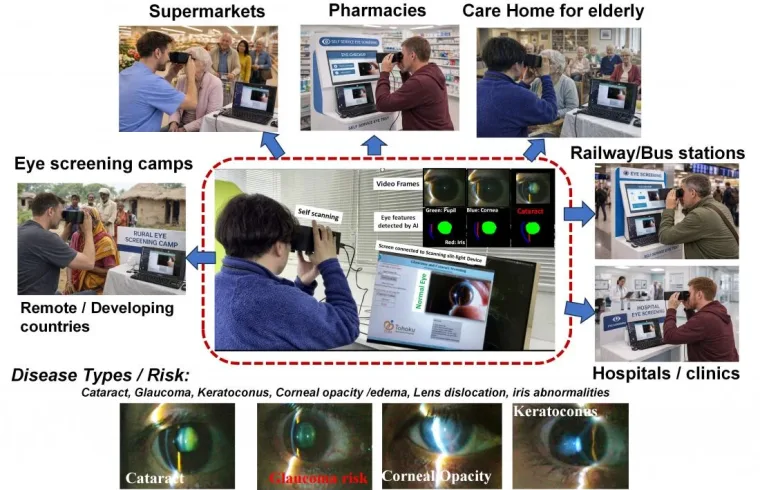
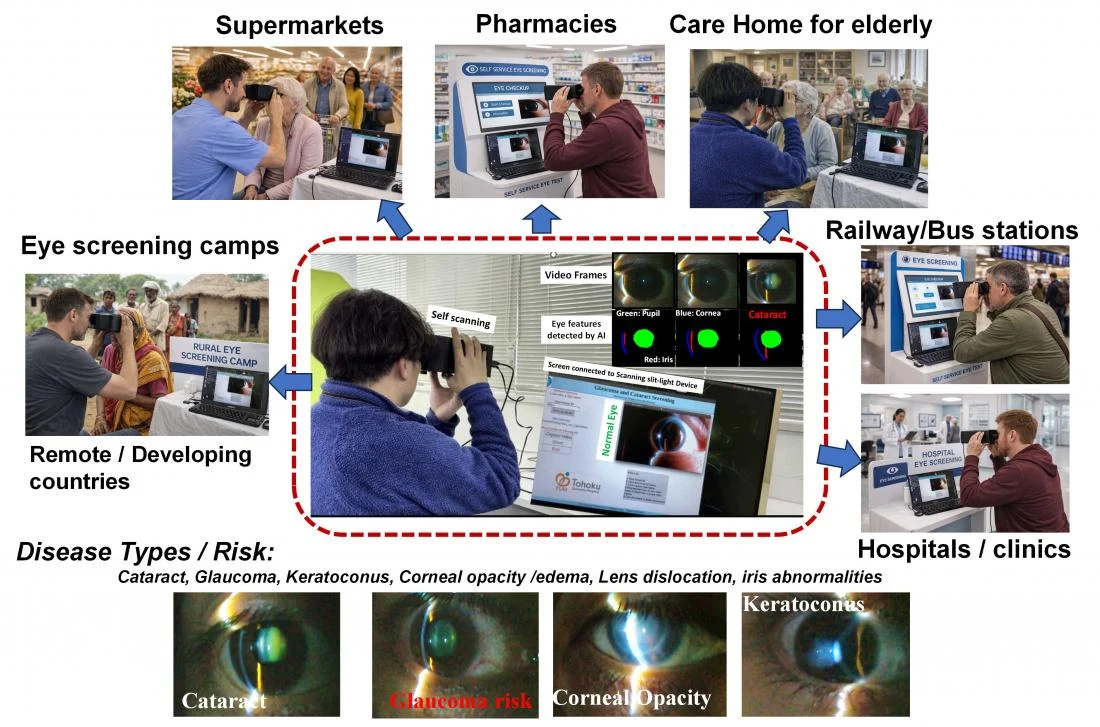
TOKYO – A team at Tohoku University has developed a portable, AI-powered slit-light scanning device that could make eye health checks possible outside hospitals, including in rural clinics, pharmacies and elderly-care facilities.
Led by Professor Toru Nakazawa at the Graduate School of Medicine, the group says the device offers a low-cost alternative to anterior-segment optical coherence tomography (AS-OCT) machines, which can cost tens of millions of yen. Their findings were published in Scientific Reports on March 17.
Diseases affecting the front of the eye, such as cataracts, are among the leading causes of visual impairment worldwide. Many patients are not screened until symptoms become severe, sometimes irreversibly. “The instruments needed for these exams are expensive, bulky, and confined to clinical settings,” Nakazawa said. “Patients in rural areas or with low mobility may not be able to access them.”
The new system captures a single scanning-slit video to provide quantitative measurements and AI-assisted evaluation of anterior-segment abnormalities. Its lightweight AI model, LWBNA-unet, runs directly on the device, segmenting anatomical structures and supporting disease classification without cloud computing.
Researchers say the device can also assess angle-closure glaucoma risk, a major concern in Asia, where early detection is critical to prevent sudden vision loss.
With portability, true-colour imaging, and on-device AI, the team believes the platform could bring routine anterior-segment screening closer to everyday life.