
The human brain processes information at vastly different speeds, from split‑second reactions to slower, reflective reasoning. A new study from Rutgers Health, published in Nature Communications, shows how the brain integrates these signals across its white‑matter pathways to support cognition and behavior.
Researchers found that different brain regions specialize in processing information over distinct time windows, known as intrinsic neural timescales (INTs). “To affect our environment through action, our brains must combine information processed over different timescales,” said Linden Parkes, assistant professor of psychiatry at Rutgers Health and senior author of the study.
Parkes and colleagues analyzed multimodal brain imaging data from 960 individuals, building detailed maps of connectivity, or connectomes. Using mathematical models, they examined how information flows through these networks. The team reported that the distribution of neural timescales across the cortex influences how efficiently the brain switches between large‑scale activity patterns linked to behavior, and that this organization varies across individuals.
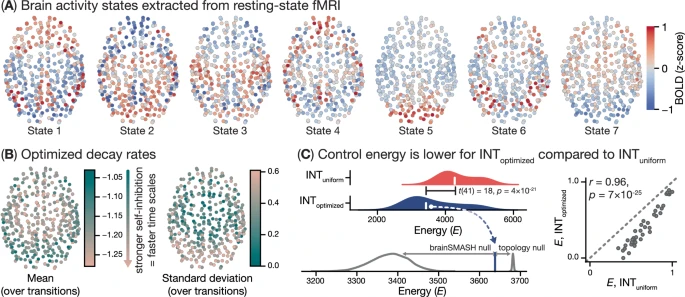
“We found that differences in how the brain processes information at different speeds help explain why people vary in their cognitive abilities,” Parkes said.
The study also tied these patterns to genetic, molecular and cellular features of brain regions, with similar relationships observed in mice, suggesting the mechanisms are conserved across species.
“Our work highlights a fundamental link between the brain’s white‑matter connectivity and its local computational properties,” Parkes said. “People whose brain wiring is better matched to the way different regions handle fast and slow information tend to show higher cognitive capacity.”
Rutgers researchers are now extending the work to study neuropsychiatric conditions including schizophrenia, bipolar disorder and depression, investigating how disruptions in connectivity may alter information processing.
The study was conducted with Avram Holmes, associate professor of psychiatry at Rutgers, postdoctoral researchers Ahmad Beyh and Amber Howell, and Jason Z. Kim of Cornell University.