
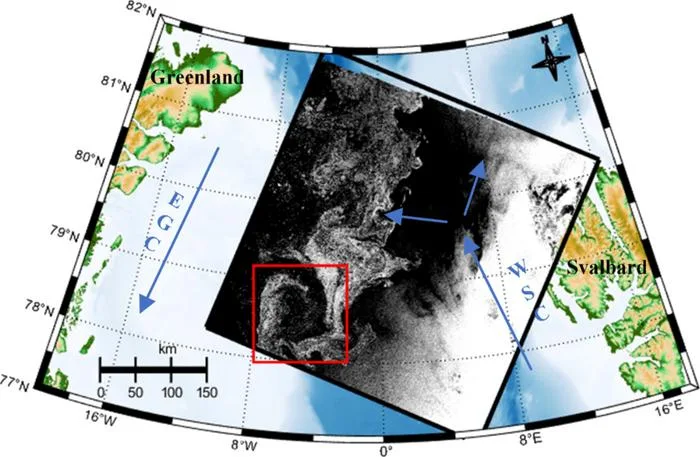
BEIJING — A research team from the Aerospace Information Research Institute of the Chinese Academy of Sciences has developed a satellite-based method to track the full life cycle of ocean eddies forming along Arctic sea-ice edges, offering new insights into polar ocean dynamics.
By combining sequential synthetic aperture radar (SAR) images with hydrodynamic modeling, the researchers reconstructed surface current fields and retrieved key dynamical parameters of a polar eddy throughout its evolution. Their findings, published in the Journal of Remote Sensing, highlight how eddies influence sea-ice transport, ocean mixing, and energy exchange between the ocean and atmosphere.
The study focused on an eddy in the Fram Strait, a critical passage between the Arctic Ocean and the North Atlantic. Using Sentinel-1A and Sentinel-1B satellite data, the team tracked sea-ice displacement to derive high-resolution current fields, which were then analyzed with a vortex-based hydrodynamic model. Results showed the eddy expanded from 28 km to over 35 km in radius, with circulation strength peaking at 4.5 × 10⁴ m²/s during its 22-day life cycle.
Researchers said the new framework allows continuous monitoring of eddy evolution, overcoming challenges posed by harsh polar conditions and limited in-situ measurements. “These eddies strongly influence sea-ice redistribution and ocean mixing in Arctic waters,” the team noted, adding that the approach could improve climate models and understanding of polar ocean–ice interactions.
The method integrates SAR remote sensing with advanced physical modeling, enabling quantitative analysis of eddy growth, maturity, and decay. Scientists believe expanding high-resolution SAR datasets will allow simultaneous tracking of multiple eddies, enhancing knowledge of Arctic circulation and its role in global climate processes.