
Cambridge, UK, Jan 23 – Demand for low-loss materials used in high-frequency circuits is set to surge sevenfold over the next decade as 5G, 6G and automotive radar systems expand, according to a new report by research firm IDTechEx.
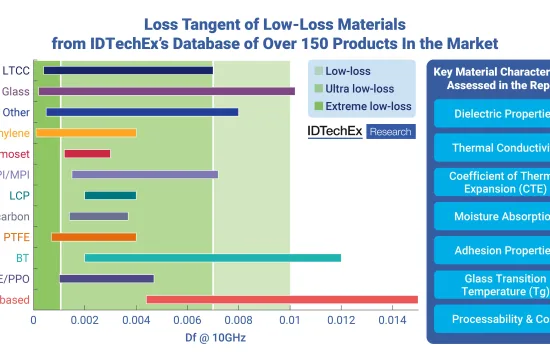
Low-loss materials (LLMs), which minimize transmission losses and preserve signal integrity, are critical for applications ranging from telecoms infrastructure to data centers and radar systems. IDTechEx said in its study “Low-Loss Materials for 5G/6G, Radar, and High-Speed Digital 2026–2036” that the market is poised for rapid growth as communication technologies move into higher frequency ranges.
Organic vs inorganic options
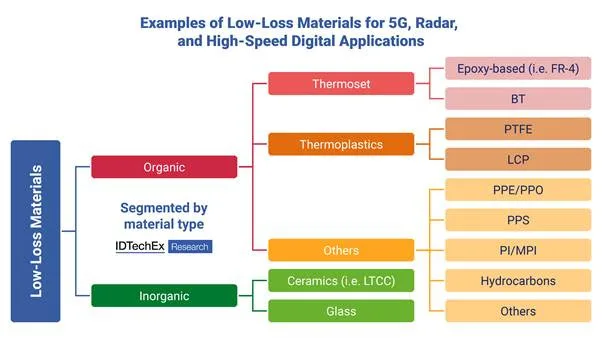
Organic materials such as PTFE, liquid crystal polymer (LCP) and polyphenylene ether (PPE) have gained traction due to cost and manufacturability, while inorganic materials like low-temperature co-fired ceramics (LTCC) and glass are valued for their low moisture absorption and stable dielectric properties. Composite approaches combining organic and inorganic materials are also emerging to balance mechanical strength with electrical performance.
Performance metrics
Key properties driving material choice include dielectric constant (Dk) and dissipation factor (Df), which determine signal stability and energy loss. Other critical factors are coefficient of thermal expansion (CTE), thermal conductivity, moisture absorption and copper foil roughness, all of which affect reliability and efficiency in printed circuit boards and RF components.
Outlook
With 77–79 GHz automotive radar becoming standard and 6G pushing into sub-terahertz ranges, the challenge for manufacturers will be to deliver ultra-low dielectric loss at scale and competitive cost. IDTechEx’s report benchmarks more than 150 commercially available materials and provides 10-year demand forecasts segmented by application and material type.