Giving lemurs the chance to use technology to share control of sensory experiences with zoo visitors can help create meaningful connections between humans and animals, groundbreaking new research suggests.
The team behind the finding, from the University of Glasgow, says the outcomes of the first trial of their ‘CreatureConnect’ system show for the first time that enabling members of two different species to share experience together through technology has value for both.
Over the course of 20 days last year, visitors to Blair Drummond Safari Park in Scotland were offered the opportunity to collaborate with the park’s five red-ruffed lemurs on a unique experiment to trigger sounds, video clips, and smells using the custom-built, computer-controlled CreatureConnect system.
The lemurs chose to engage most often with CreatureConnect when they could collaborate with humans to control the stimuli, suggesting they were finding value in the experience. At the same time, visitors were thrilled by the chance to engage with the lemurs, staying significantly longer at their enclosure and reporting high levels of empathy with the animals.
The researchers believe their findings could help bridge the gap between zoo animals’ need for personal space, privacy, and agency and zoo visitors’ desire to create personal connections with animals during their trips.
By providing a means of mutually entertaining, indirect contact between the two, it could help enrich the lives of zoo animals in new ways and inspire greater support for wildlife conservation efforts from their human counterparts.
The results of the research will be presented as a paper at the CHI 2026 conference later this month.
Dr Ilyena Hirskyj-Douglas leads the University of Glasgow’s Animal-Computer Interaction research group and is the paper’s corresponding author. She said: “Technology can enable humans to communicate with each other directly in lots of different ways. We chat on the phone, we text each other, we video call, and those shared experiences can enrich our lives.
“As part of our ongoing research relationship with Blair Drummond Safari Park, we wanted to explore whether offering shared control of technology could create a bridge between species that would be valuable for both.
“Our findings suggest for the first time that we can not only share experiences with other species using technology, but that, in this case, red-ruffed lemurs want to share them with us and prefer sharing to solo control.”
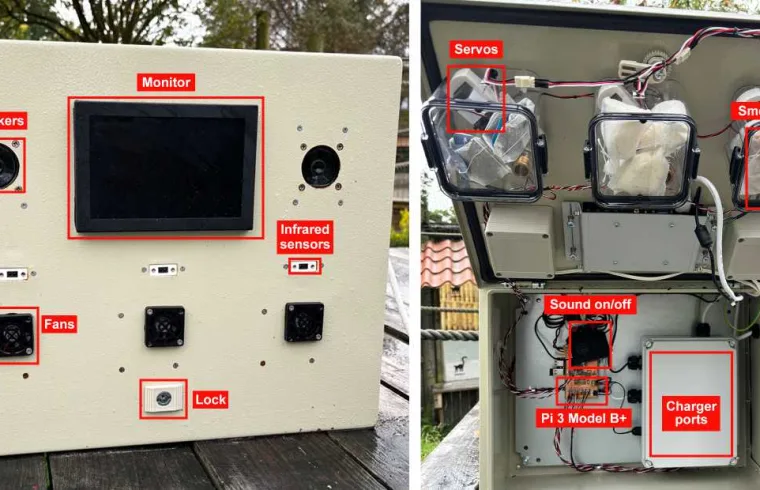
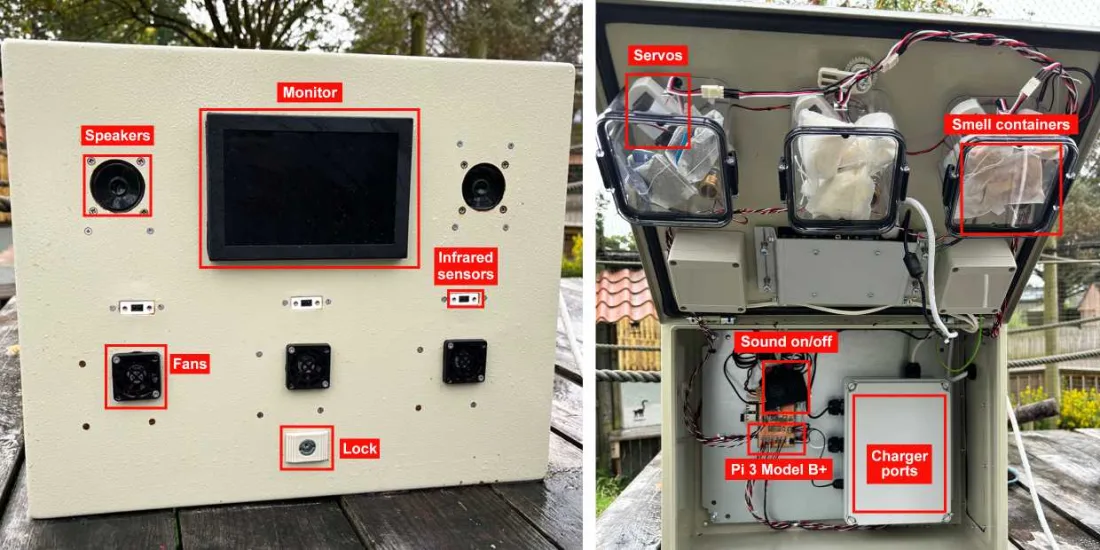
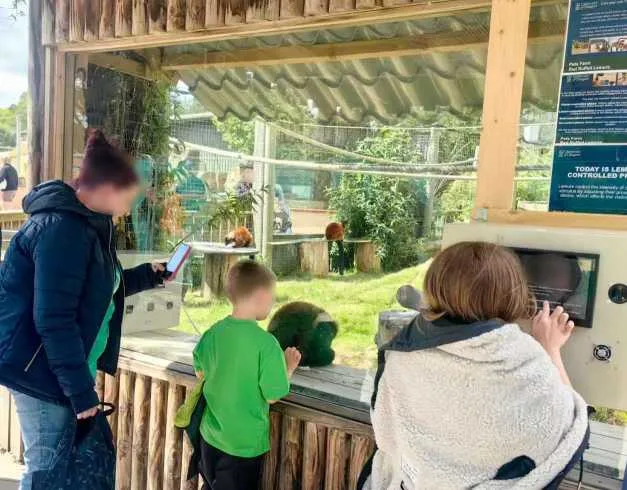
The custom-built, computer-controlled CreatureConnect system was split into two devices, with one placed on either side of the lemur enclosure’s glass partition. On both sides, it provided a digital interface that gave humans and lemurs alike control over the triggering of sounds, video footage, and scents.
On the animals’ side, it took the form of a box with speakers, a screen, and a device to release scents. When a lemur approached the device, a distance sensor triggered sounds like music or rainforest ambience, visuals including an underwater scene and abstract patterns, and the smell of apple, lavender, and mango. Moving closer raised the intensity of the stimuli, while moving further away dialled them down.
The system offered lemurs a randomly-chosen mix of two sights, sounds, or smells based on previous research with the park’s animals, which showed the lemurs preferred to have more than one stimulus at a time.
On the visitors’ side, humans controlled the stimuli using sliders on a touchscreen display, allowing them to adjust the intensity of the sensory modes when it was their turn to control the system.
During the 20 days CreatureConnect was on display at the park, more than 16,000 people visited the lemur enclosure. 1,719 of them used the system for themselves, and the lemurs interacted with it 541 times directly.
The team tested four variations of the way the system worked to gather data on the responses of the human and animal users to each, working from fully automatic triggering of the stimuli to human-only, lemur-only, and shared human-lemur control.
They found that lemurs were least engaged when they had full control, and most engaged when they shared control with humans. They also had clear preferences for the content they engaged with, showing the greatest response to high-intensity scents, bright visuals, and medium-intensity sound.
Humans were similarly engaged by shared control, with survey responses showing high levels of engagement, enjoyment, and empathy towards the animals. Visitors stayed longer at the enclosure, watched the lemurs more closely, and talked more often about the animals’ behaviour and welfare. Visitors also reported feeling a stronger sense of connection with the lemurs when they could see the animals responding to the changes they made on the touchscreen.
Footfall and dwell time at the enclosure also increased significantly on days when CreatureConnect was available. More visitors stopped at the enclosure, and many stayed longer, compared to observations the team made on days without the system.
Jiaqi Wang, a PhD student at the University of Glasgow’s School of Computing Science, is the paper’s first author. She said: “When we were designing the system, we suspected that humans would respond more strongly to shared control than the lemurs, and that lemurs would prefer to do their own thing.
“We were surprised to find that the lemurs do not necessarily want to control the device alone. Instead, they seem to want to share, and that has a very clear impact on visitors’ interest in the lemurs and their desire to spend more time with and learn about them.
“Red-ruffed lemurs are a critically endangered species that need help to recover their numbers in the wild. Using technology to foster high levels of engagement and empathy could help zoo visitors leave not just with happy memories but also with a keener interest in wildlife conservation.”
The research expands on an ongoing research relationship between Glasgow computing scientists and zookeepers at Blair Drummond Safari Park.
Lorna Graham, Research Coordinator at Blair Drummond Safari Park, said: “We’re absolutely delighted to have been involved in this innovative project. We’re always looking for evidence-based ways to enhance the well-being of the animals in our care, and CreatureConnect gave our lemurs the opportunity to make choices and share experiences on their own terms.
“It’s been fascinating to see how engaged both visitors and lemurs were when collaborating with each other. When people can see the lemurs responding and making their own choices, something really seems to click. That shared moment creates a genuine connection – and when you feel connected to an animal, you’re far more likely to care about its future.
“Research like this helps us better understand what our animals value, while also building deeper empathy between people and wildlife. That’s incredibly powerful for the future of conservation.”
Dr Hirskyj-Douglas added: “One of the most exciting directions for this research is thinking about what happens when we move beyond charismatic animals like lemurs, which people find easy to relate to.
“What might happen if we were to try this with a spider, or an insect, or another animal that visitors might be less naturally drawn to? If technology can create a genuine moment of shared experience between a human and one of these zoo residents, it could enable similar growth of empathy for visitors.
“It’s hard to make people care about a part of the natural world they’ve never felt a connection with, so kindling those feelings through technology could have a transformative impact on support for conservation efforts. We’re keen to explore this in future research with Blair Drummond.”
Professor Stephen Brewster of the University of Glasgow’s School of Computing Science contributed to the research and co-authored the paper. The team’s paper, titled ‘CreatureConnect: Exploring Shared Control of Multimodal Interaction by Humans and Lemurs’, will be presented at the CHI 2026 conference in Barcelona on Monday, 13 April.