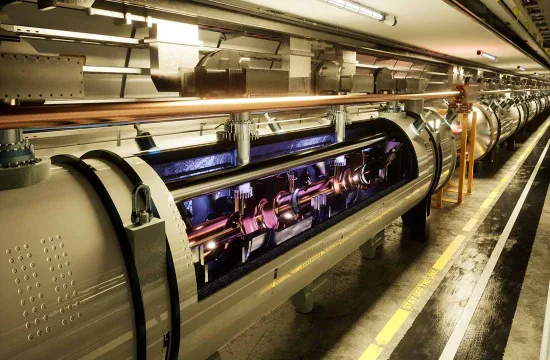
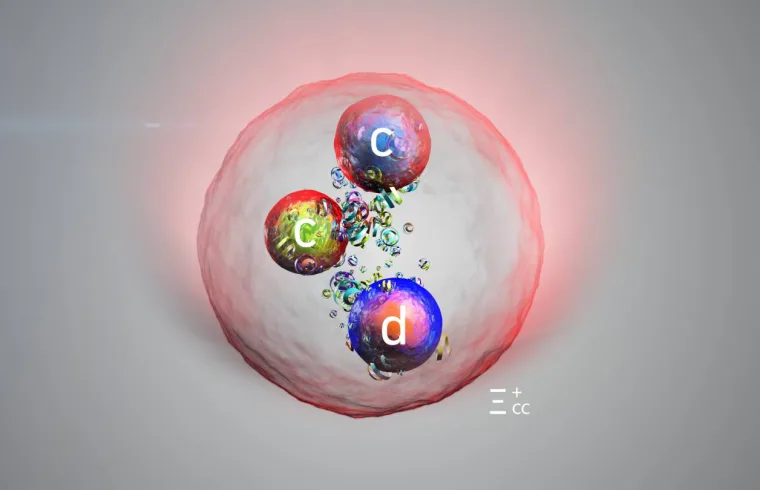
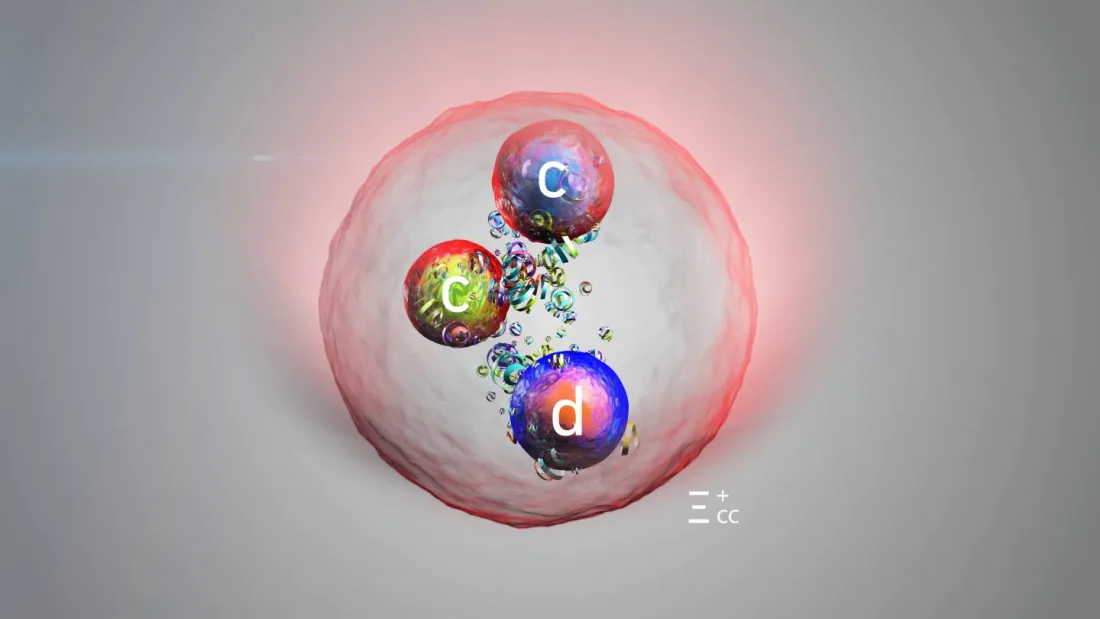
Geneva, March 23 – CERN’s Large Hadron Collider has produced a new particle made of two charm quarks and one down quark, researchers said at the Moriond conference, marking only the second time a baryon with two heavy quarks has been observed.
The particle resembles a proton but is about four times heavier, with two charm quarks replacing the proton’s two up quarks. Scientists said the discovery will help test quantum chromodynamics, the theory describing how the strong force binds quarks into protons, neutrons and other hadrons.
The LHCb Collaboration observed the baryon in proton–proton collisions during the collider’s third run, with a statistical significance of 7 sigma, well above the 5 sigma threshold required to claim a discovery.
“This is the first new particle identified after the upgrades to the LHCb detector completed in 2023,” said LHCb Spokesperson Vincenzo Vagnoni. “It will help theorists refine models of the strong force and explore exotic hadrons such as tetraquarks and pentaquarks.”
A similar particle with two charm quarks and one up quark was reported in 2017. The new version, with a down quark instead, is predicted to have a lifetime up to six times shorter, making it harder to detect.
“This major result highlights how upgrades at CERN directly lead to new discoveries,” said CERN Director-General Mark Thomson. “It sets the stage for the transformative science expected from the High-Luminosity LHC.”