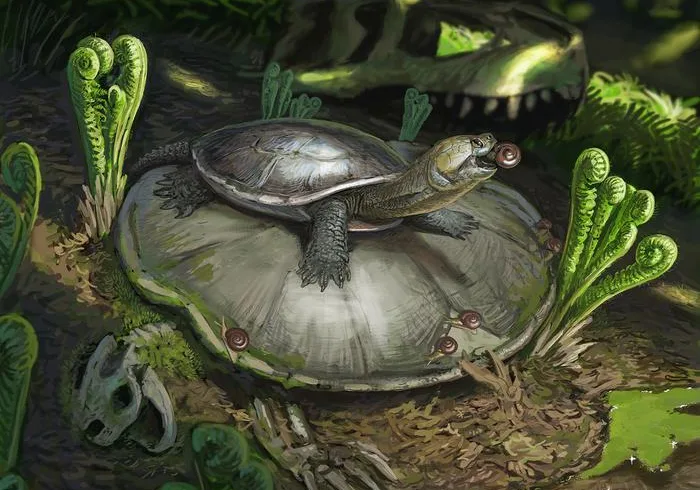
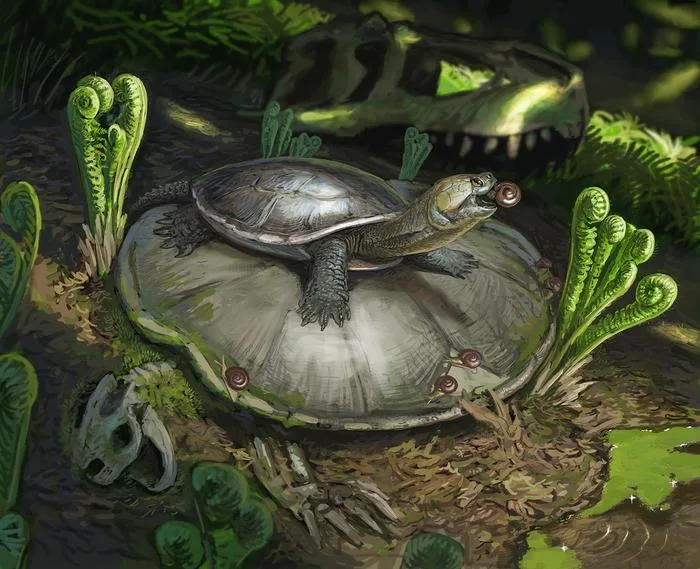
BERLIN – Turtles that fed on hard-shelled prey such as gastropods and bivalves were far more likely to survive the mass extinction that wiped out the dinosaurs 66 million years ago, according to new research.
The study, led by paleontologist Serjoscha Evers of the Bavarian State Collection of Natural History (SNSB), shows that turtles specializing in hard-shelled diets were more than five times as likely to endure the Cretaceous-Paleogene catastrophe compared with fish-eating or herbivorous species.
“We are observing an ecological filter. Specializing in hard-shelled food gave these turtle species an evolutionary advantage,” Evers said. He explained that mollusks proved resilient to the asteroid impact’s fallout, while herbivores and carnivores struggled in the “nuclear winter” that followed.
Evers and doctoral student Guilherme Hermanson of the University of Fribourg analyzed anatomical features of turtle jaws to reconstruct dietary patterns across lineages at the extinction boundary. Statistical models revealed diet as a decisive ecological factor in survival.
Evers, who also directs the Urwelt-Museum Oberfranken, said the findings highlight how ecological specialization influenced evolutionary outcomes. “Turtles that relied on resilient food sources faced less pressure,” he noted.
The research underscores how selective ecological traits helped certain vertebrates endure one of Earth’s most catastrophic events.