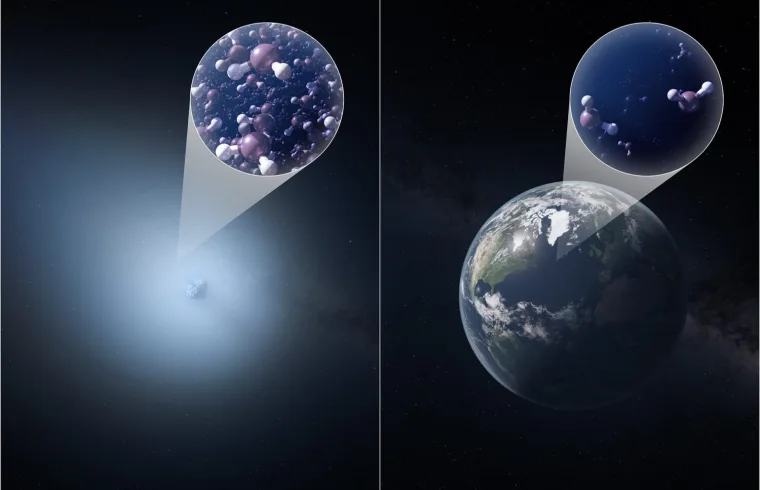
SANTIAGO — Astronomers using the Atacama Large Millimeter/submillimeter Array (ALMA) in Chile have made the first-ever measurement of deuterated water, or semi-heavy water, in an interstellar object, detecting unusually high levels in comet 3I/ATLAS.
The study, led by University of Michigan PhD student Luis E. Salazar Manzano with assistant professor Teresa Paneque-Carreño, found that the comet contains at least 30 times more semi-heavy water than comets in our Solar System, offering rare chemical clues to the frigid environment in which its home star system formed.
“Our new observations show that the conditions that led to the formation of our Solar System are much different from how planetary systems evolved in different parts of our Galaxy,” Salazar Manzano said.
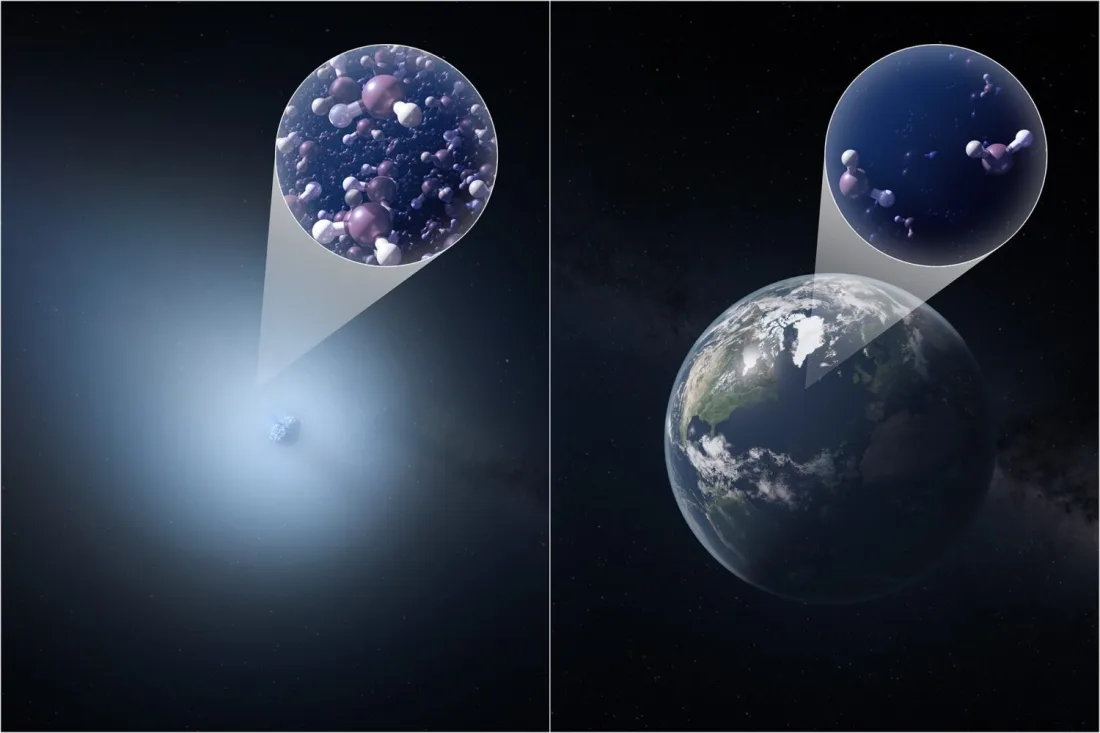
Comets, often described as “dirty snowballs,” preserve frozen records of their birth environments. In Solar System comets, semi-heavy water molecules occur at a ratio of about one in 10,000 compared to ordinary water. In 3I/ATLAS, the ratio is at least 30 times higher, exceeding levels found in Earth’s oceans.
Ordinary water itself was below ALMA’s detection threshold, so the team inferred production rates indirectly by modeling methanol emissions. The elevated ratio points to an origin in temperatures below 30 Kelvin (minus 406 degrees Fahrenheit), conditions that enhance deuterium enrichment.
Paneque-Carreño noted ALMA’s unique ability to observe near the Sun, allowing measurements just days after the comet’s closest approach. “Most instruments can’t point toward the Sun, but radio telescopes like ALMA can,” she said.
Scientists say the findings carry cosmological significance, since hydrogen and deuterium abundances were set during the Big Bang. “Each interstellar comet brings a little bit of its history, its fossils, from elsewhere,” Paneque-Carreño added. “With instruments like ALMA we can begin to understand the conditions of that place and compare them to our own.”