
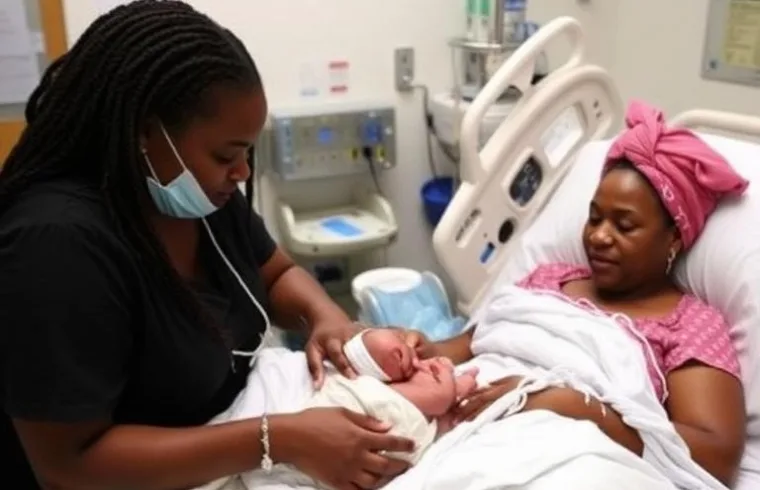
LOS ANGELES – Low-risk patients at predominantly Black-serving hospitals (BSH) who previously gave birth through Cesareans are likelier to attempt and successfully deliver vaginally in a subsequent pregnancy than they are at hospitals treating few Black patients, new UCLA-led research finds.
Still, Black patients were less likely to achieve a successful vaginal birth after Cesarean (VBAC) than their white counterparts, regardless of the hospital type, the researchers found.
“Black women in the United States have a higher rate of cesarean deliveries and already face much higher rates of severe pregnancy complications and death,” said Dr. Max Jordan Nguemeni, assistant professor of medicine, division of general internal medicine and health services research at the David Geffen School of Medicine at UCLA, and the study’s lead author.
“Our findings show that where someone gives birth matters, and that certain hospitals appear better equipped or more willing to support labor after cesarean, even for patients who face higher risks of adverse obstetric outcomes.”
The paper is published in the peer-reviewed journal Obstetrics & Gynecology.
The researchers analyzed 2017-2019 data from the US National Inpatient Sample on more than 1.7 million patients who had undergone cesareans, focusing only on low-risk deliveries. They grouped hospitals into three categories: high Black-serving, medium Black-serving, and low Black-serving.
It found that patients at high Black-serving hospitals were 25% more likely to attempt labor, with about 75% succeeding, particularly at urban teaching hospitals. By contrast, only 18% of patients at low Black-serving hospitals attempted labor, with roughly 70% achieving VBAC.
Overall, Black patients at high Black-serving hospitals had a 72% likelihood of success compared with 67% at low Black-serving facilities. Still, Black patients were less likely to achieve VBAC than white patients across all hospital types.
Avoiding unnecessary repeat cesareans improves maternal health and safety, reduces long-term health risks, and lowers healthcare costs, Nguemeni said.
“Cesarean births carry higher risks of complications like infection, bleeding, and future pregnancy complications like placenta accreta, which is on the rise,” he said. “These risks accumulate with each repeat cesarean.”
Previous research found that Black-serving hospitals provide worse care, he said. These latest findings add nuance by showing that BSH’s can perform better than other hospitals on some outcomes by supporting labor following cesareans; shining the light on the role that institutional practices, resources, and culture play in providing care; and highlighting how racial disparities and hospital segregation work together rather than operating separately.
“In short, disparities are not inevitable; they are shaped by existing systems and individuals’ decisions,” he said.
Two findings stood out in particular, Nguemeni said. One was that BSHs are often under-resourced and have higher rates of labor after cesarean and VBAC, particularly at teaching hospitals. Another was that teaching hospitals demonstrated large differences depending on the number of Black patients they treated, even when their resources were similar.
“This suggests that culture, norms, and clinical comfort, and not just technology and resources, play an important role,” he said. “These challenges simplistic narratives about hospital quality and highlight where positive lessons may already exist.”
Study limitations include the researchers’ inability to distinguish between patients with single or multiple cesarean deliveries, as well as an inability to determine causation due to the cross-sectional nature of the data.
The next step in the research is to examine staffing models, labor management protocols, and the use of operative vaginal delivery; how clinical decision tools are used; and training, experience, and institutional culture to understand why some hospitals do better than others.