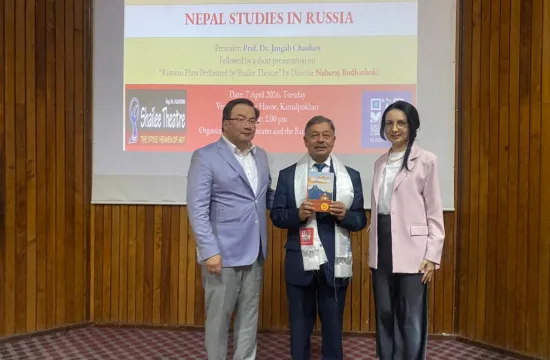
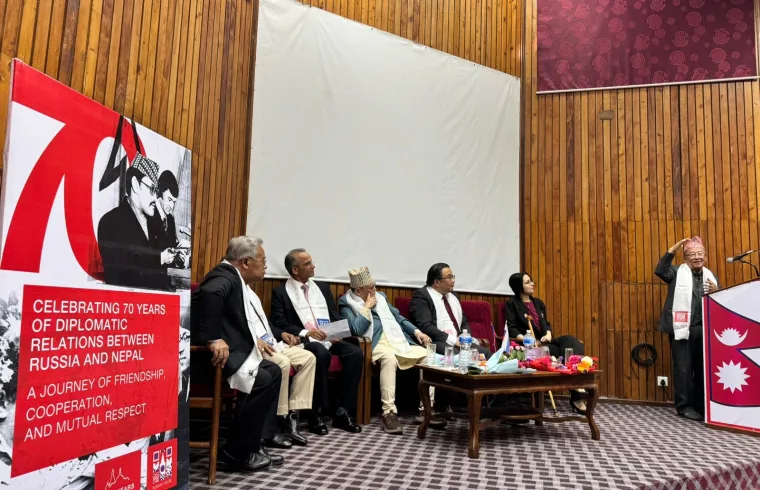
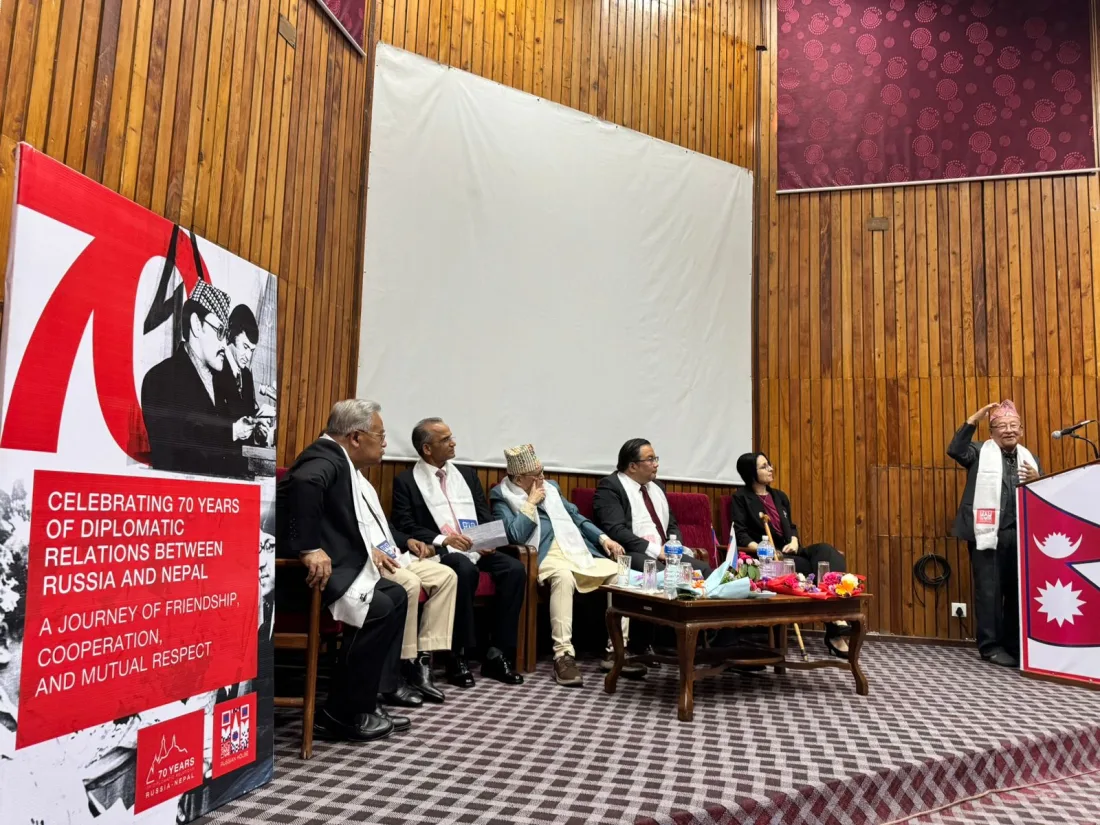
Kathmandu — Nepal and Russia marked the 70th anniversary of their diplomatic relations with a high-level discussion at Russian House in Kathmandu, highlighting both the historical depth and future trajectory of bilateral ties.
The event brought together prominent figures including former Foreign Minister Ramesh Nath Pandey; Ganesh Prasad Dhakal, Joint Secretary (Europe Division) at Nepal’s Ministry of Foreign Affairs; Rinchen Rakshaev, Chargé d’Affaires of the Russian Embassy in Nepal; and former Ambassador to Russia Hiranaya Lal Shrestha. The program was chaired by Swaraj Shakye, General Secretary of the Nepal-Russia Friendship and Cultural Association, alongside Executive Member Sugat Ratna Kansakar.
Speakers emphasized that the relationship, established in 1956, has grown beyond formal diplomacy to encompass cooperation in infrastructure, hydropower, healthcare, and human resource development. Russia’s contributions through technical assistance, academic exchanges, and capacity-building initiatives were noted as leaving a lasting legacy in Nepal.
In her opening remarks, Anastasia Khokhlova underscored the humanitarian dimension of the partnership, stating that its strength lies in “sustained cultural and educational exchange that connects our peoples across generations.”
Ganesh Prasad Dhakal, serving as Guest of Honour, outlined Nepal’s expectations for international partnerships in the post-election context, stressing priorities in infrastructure, education, technology transfer, and capacity building. He also highlighted the role of Russian House in promoting science, cultural exchange, and scholarships for Nepali students.
Former Foreign Minister Pandey, in his keynote address, called for modernization of the partnership, remarking that “true friendship between nations is tested not in formal agreements, but in continued relevance to the aspirations of their people.”
Tourism and cultural connectivity were identified as underutilized areas of cooperation. Sugat Ratna Kansakar suggested that direct air connectivity and increased Russian visitor flow could transform bilateral ties into a more visible and economically beneficial partnership.
Concluding the program, Rinchen Rakshaev reaffirmed that Nepal-Russia relations remain guided by principles of equality, mutual respect, and non-interference, recalling decades of collaboration in key development sectors.
The anniversary was framed not merely as a retrospective milestone, but as a strategic moment to recalibrate ties. With shared priorities in education, youth exchange, tourism, and cultural cooperation, Nepal and Russia signaled their intent to evolve the relationship into a dynamic partnership aligned with Nepal’s development ambitions.