
Beijing – Satellite navigation systems can falter not only during dramatic space weather events but also when the ionosphere develops sharp regional structures that global correction models fail to capture, according to new research published in Satellite Navigation.
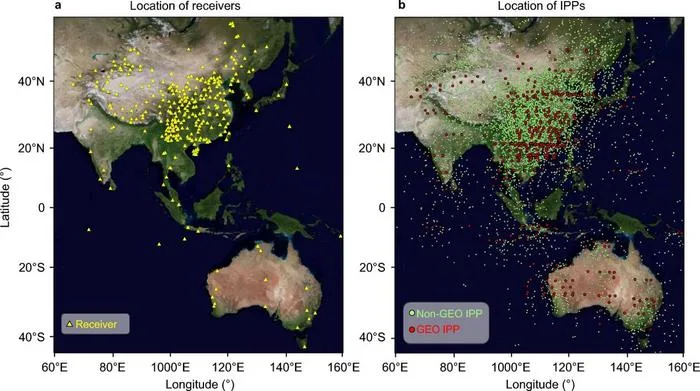
The study, led by the Institute of Geology and Geophysics at the Chinese Academy of Sciences (CAS) with collaborators from several universities, shows that steep longitudinal gradients in total electron content (TEC) over Asia can cause significant positioning errors. Using data from more than 300 GNSS receivers, ionosonde readings, and radar measurements, the team found TEC gradients exceeding 2 TECU per degree between 20°N and 30°N—too fine for most global ionosphere models to resolve.
While some models, such as CASG and JPLG, performed better than others, even JPLG failed to capture more than half of the strongest gradients. As a result, standard point positioning (SPP) errors increased, though CASG reduced those errors by up to 2 meters compared with alternatives.
Storm-Time Effects: Amplifying or Suppressing Errors
The research also examined geomagnetic storms, revealing that storm-time electric fields can either worsen or improve navigation accuracy. During the December 1, 2023 storm, upward plasma drift intensified post-sunset irregularities, degrading precise point positioning (PPP) accuracy from under 10 centimeters to meter-level errors. In contrast, the May 10, 2024 storm drove downward plasma drift, suppressing irregularities and preventing extra PPP errors.
“This study shows that the ionosphere is not just background noise for satellite navigation,” the authors noted. “Its regional structures can rapidly reorganize positioning conditions, and storm-time electric fields can push the system in opposite directions—either amplifying errors or suppressing them.”
Operational Implications
The findings highlight the need for more nuanced GNSS warning systems in Asia, particularly for industries relying on high-precision navigation such as surveying, transport, and autonomous technologies. Future improvements could include finer longitudinal resolution, multi-constellation data integration, and more realistic multi-layer ionosphere models.
By distinguishing between harmful and protective storm-time conditions, the study suggests that GNSS forecasting can become not only more accurate but also more actionable for real-world users.