
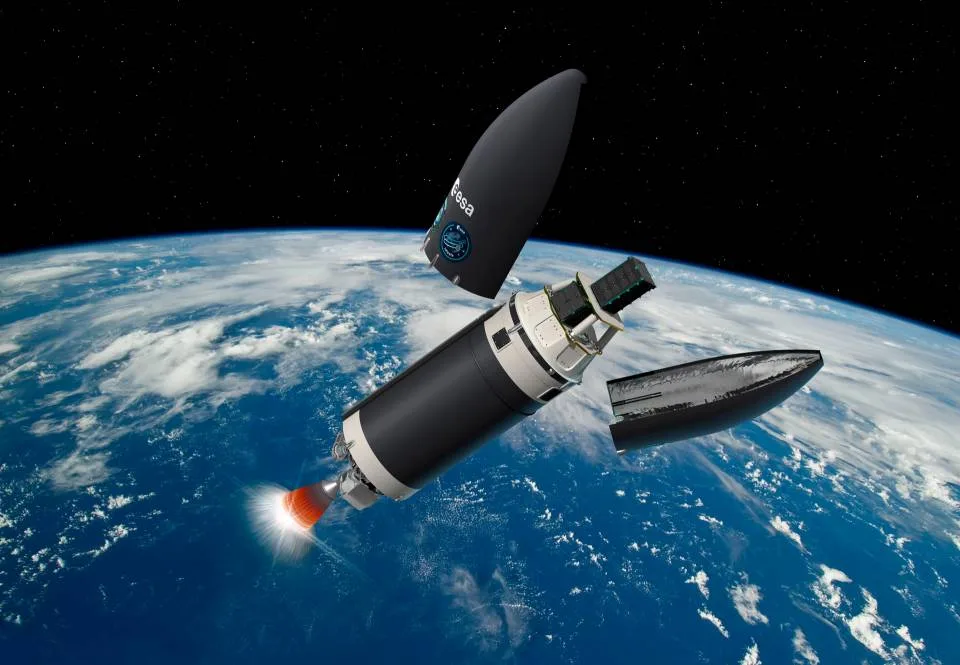
The European Space Agency (ESA) launched the first two satellites of its Celeste mission on Friday, marking a step toward strengthening Europe’s satellite navigation capabilities with a low Earth orbit (LEO) layer to complement Galileo.
The spacecraft, built by GMV and Thales Alenia Space, lifted off aboard Rocket Lab’s Electron rocket from New Zealand at 10:14 CET. They separated from the launcher about an hour later, entering their early operations phase.
Celeste will validate new signals, service capabilities, and core technologies, while activating required L- and S-band frequencies in line with International Telecommunication Union rules. ESA plans to expand the constellation to 11 satellites by 2027, enabling experiments across multiple frequency bands and applications.
“Celeste will demonstrate how a navigation constellation in low Earth orbit can complement Europe’s Galileo system,” ESA Director General Josef Aschbacher said. He added that the mission reflects a “New Space-inspired approach” for faster and more flexible deployment.
ESA Navigation Director Francisco-Javier Benedicto Ruiz said the project would enhance resilience and robustness of Europe’s positioning systems, while opening new services.
Flying closer to Earth, Celeste aims to deliver stronger signals and support applications ranging from autonomous transport and aviation to emergency communications, IoT tracking, and indoor navigation.
The demonstration phase, backed by ESA member states, will prepare European industry for a potential operational LEO navigation layer to complement Galileo and EGNOS.