UNIVERSITY PARK, Pa. – Researchers led by Penn State’s Bruce Logan have developed a reactor that converts carbon dioxide and renewable electricity into methane at a scale roughly ten times larger than previous designs, without losing efficiency.
The study, published in Water Research, demonstrates that microbial electrosynthesis systems can be expanded beyond laboratory devices while maintaining high energy efficiency and methane output.
The reactor uses electricity from solar or wind to split water and generate hydrogen. Microorganisms known as methanogens then consume the hydrogen to convert carbon dioxide into methane, which can be stored and transported through existing natural gas infrastructure.
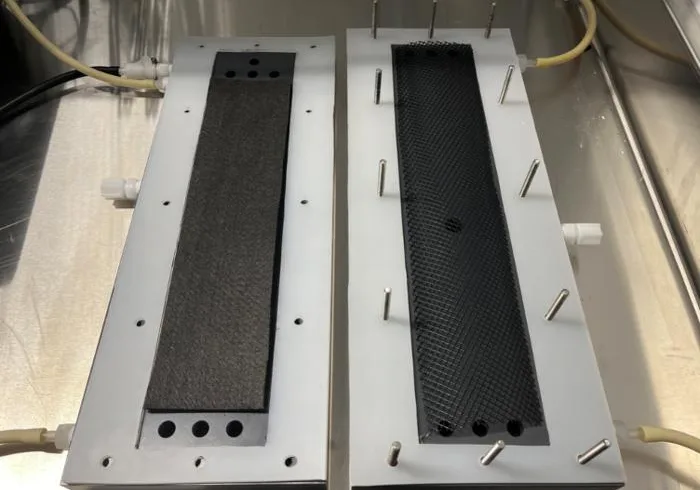
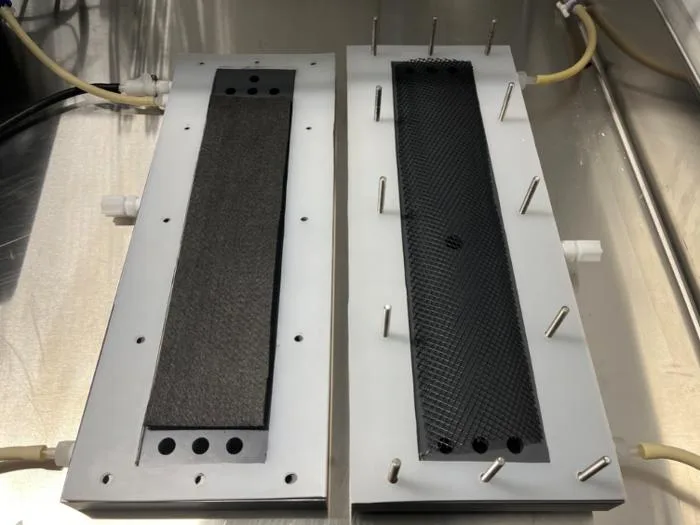
The team’s “zero-gap” reactor design places electrodes directly against a membrane, reducing internal resistance. The system increased electrode area tenfold and extended the flow path to nearly 12 inches, while maintaining performance. Multiple flow ports distribute fluids and gases evenly.
In tests at 30°C, the reactor produced up to 6.9 liters of methane per liter of reactor volume per day, with coulombic efficiencies above 95%. Energy efficiency reached about 45%, among the highest reported for microbial electrosynthesis systems.
Logan said the hydrogen-mediated pathway allows faster methane production compared to direct electron transfer. “We split water to make hydrogen, and the methanogens are right there to use it immediately,” he explained.
The findings suggest microbial electrosynthesis can be scaled effectively if reactor design supports efficient hydrogen transport and stable microbial activity. Logan said future systems could be paired with renewable energy sources, producing methane on-site for injection into gas pipelines.
Economic viability will depend on access to low-cost renewable electricity, improved catalysts, and strict control of methane leakage. Still, Logan said the approach offers a pathway to recycle carbon dioxide into a storable fuel.