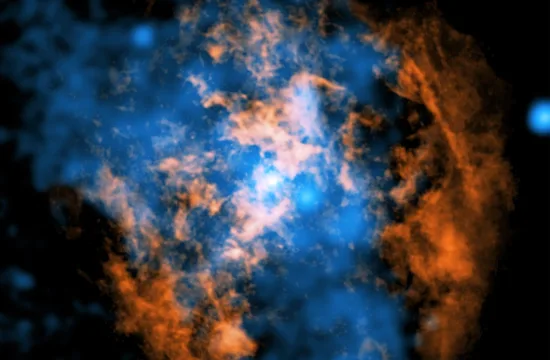
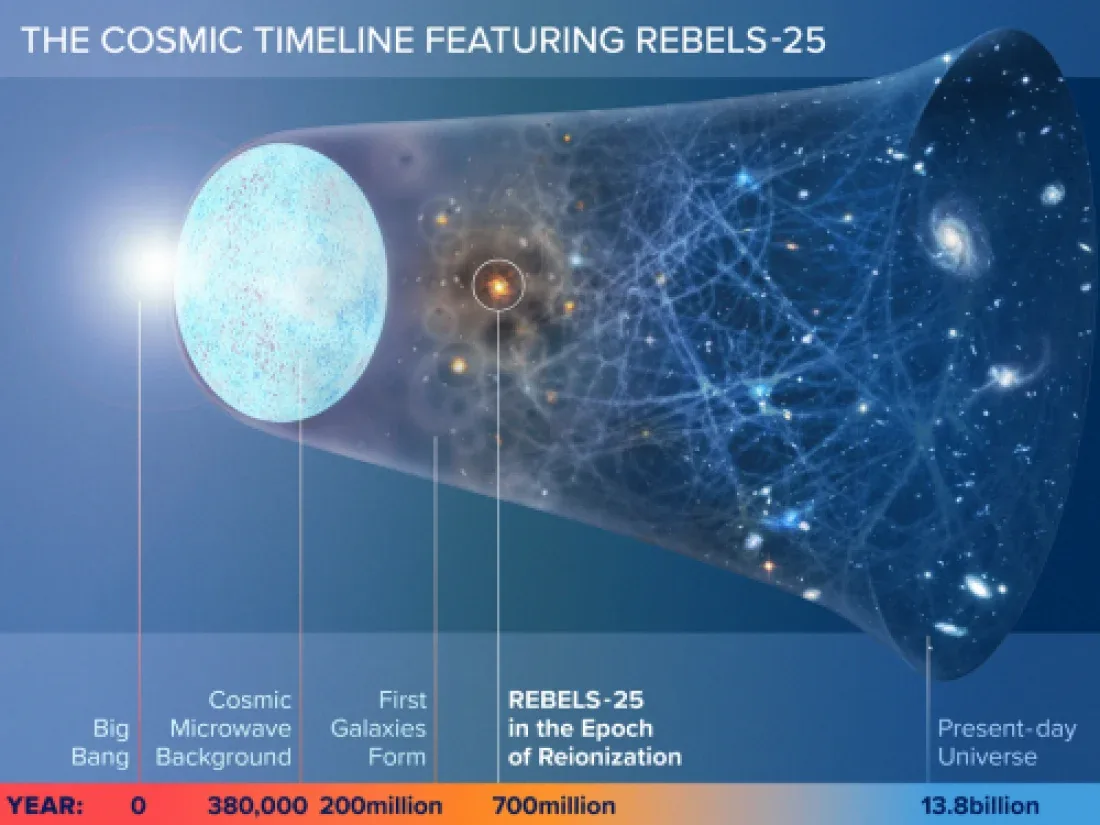
Astronomers have discovered a vast reservoir of cold molecular gas — the raw material for star formation — in REBELS-25, a massive galaxy seen just 700 million years after the Big Bang.
The team, led by Leiden University in the Netherlands, detected faint radio emission from carbon monoxide molecules using the U.S. National Science Foundation’s Very Large Array (VLA) in New Mexico, alongside data from the Atacama Large Millimeter/submillimeter Array (ALMA) in Chile. The findings mark the most distant detection of low-energy carbon monoxide to date.
REBELS-25 lies at redshift z=7.3, deep in the Epoch of Reionization, when the first stars and galaxies transformed the early universe. The brightness of the signal suggests the galaxy contained a large supply of star-forming material at a very young cosmic age.
“Galaxies just 700 million years after the Big Bang already contained large reservoirs of cold gas available for star formation,” said Karin Cescon, a PhD student at Leiden University and lead author. “With these deep NSF VLA observations, we were able to overcome the observational challenges posed by the cosmic microwave background.”
The cosmic microwave background, relic radiation from the Big Bang, makes detecting faint gas emissions at high redshift difficult. The team’s success provides direct evidence that early galaxies grew rapidly by converting large gas supplies into stars.
“Recent observations suggest that galaxies in the early universe grew much faster than we once thought,” said co-author Hanae Inami of Hiroshima University in Japan. “Our discovery adds new evidence for this picture and opens the door to understanding how these early galaxies formed stars so efficiently.”
The study, published in the Monthly Notices of the Royal Astronomical Society, highlights the potential of the planned Next-Generation Very Large Array (ngVLA), which will be able to detect such signals about 10 times faster and across larger samples of galaxies.
“This NSF VLA detection is an exciting sneak peek of what’s to come with the ngVLA,” said Professor Jacqueline Hodge of Leiden University. “It will allow us to find and study cool gas in many more young galaxies, including those at even earlier times.”
The international team included researchers from institutions in Europe, Asia, Australia, and the Americas.