
A searing heatwave has swept across Europe, smashing temperature records in multiple countries and triggering health warnings, drought alerts and wildfire risks, according to meteorological agencies.
The World Meteorological Organization (WMO) said the extreme heat, which began in the Iberian Peninsula, has spread across Western, Central and Southern Europe and is expected to intensify in the Balkans by the end of June.
Germany reported its hottest day on record on June 28, with 41.7°C measured in Coschen near the Polish border. The Deutscher Wetterdienst (DWD) said 252 weather stations logged all-time highs, with overnight temperatures also breaking records. Hungary, Poland, the Czech Republic and Austria reported new June records above 40°C, while the UK saw its hottest June days on record for three consecutive days, peaking at 37.3°C in southern England.
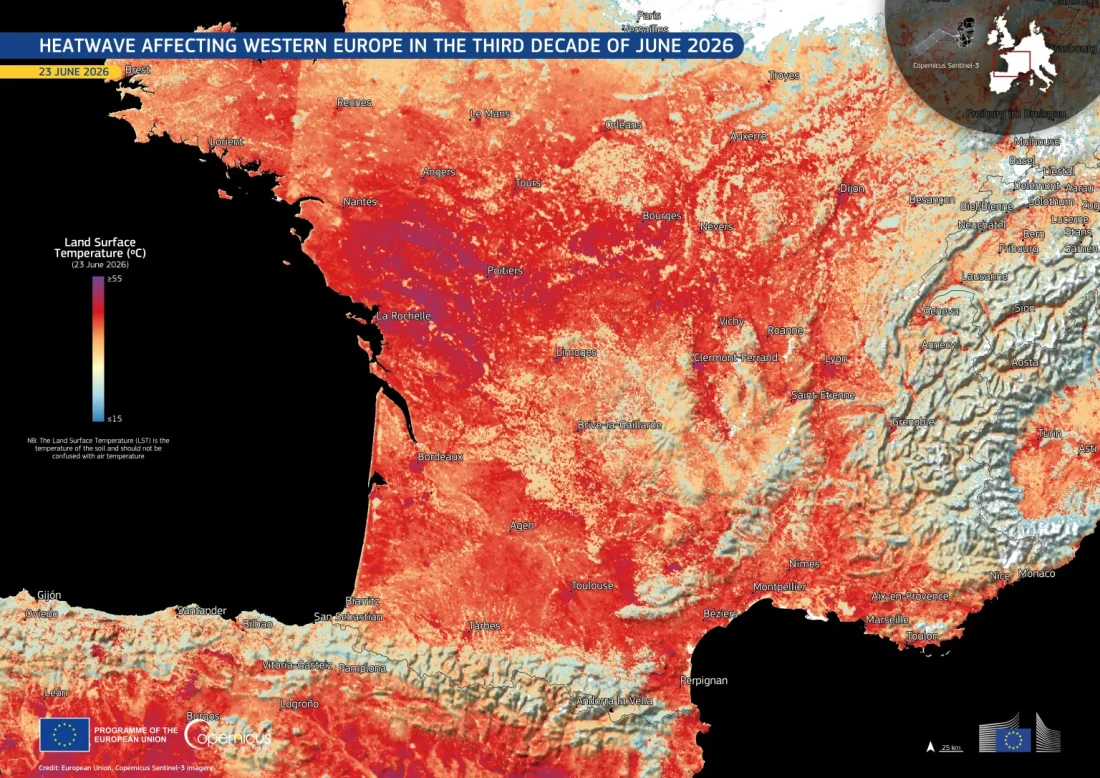
France endured its hottest day ever on June 24, with a national average of 30°C and local highs of 43.8°C. Authorities issued top-level Red Alerts for 58 departments, warning of wildfire risks amid worsening drought. Spain also recorded its hottest June days, with Bilbao reaching 42.7°C.
Other countries including the Netherlands, Denmark, Switzerland and Italy reported unprecedented highs, with national meteorological services issuing rare Red Alerts.
The World Health Organization (WHO) said more than 1,300 excess deaths have been linked to the heat since June 21, with over 150 million people affected. Experts warned that prolonged exposure, especially when nights remain hot, poses severe risks to vulnerable groups including the elderly, children, outdoor workers and people with chronic illnesses.
“Heatwaves like this are what we expect to see in a changing climate,” said John Kennedy, head of climate information at WMO. Europe has warmed by about two degrees Celsius since 1976, making it the fastest-warming continent.
UN Secretary-General António Guterres, speaking at London Climate Week, said the world has lived through the 11 hottest years ever recorded. “Climate disasters are becoming more frequent, more destructive, and more costly,” he said, warning that the developing El Niño could further disrupt food and water systems.
The WMO and WHO are coordinating heat-health action plans and early warning systems under the UN’s “Early Warnings for All” initiative, aimed at reducing deaths and economic disruption from extreme heat.